C is for Capo Ferro

Lunge
Capo Ferro has not nothing to do with Italian food or stringed instruments.
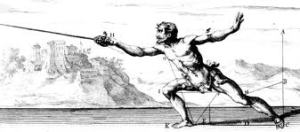
It, or rather he, has everything to do with what we know about actual rapier, rapier and dagger, and sword and buckler (shield) fighting from the renaissance period. Since we don’t have film from back then and no photographs, we have to go by line drawings and any books that were written that described it like the one above from Capo Ferro’s book Italian Rapier Combat originally published in 1610. I bought my copy in Portland from Powell’s Books (awesome indi and just a huge huge store). This book is a series of plates with short explanations of the positions and moves of Italian rapier fencing. The Italians were known in the 16th into the early 17th century to be the best with the sword. The French surpass them later but not for a long long time. Ferro was a fencing master in the city of Siena. My favorite are the many images that show (see below) what happens when you are successful in attack. Notice the three different angles the blade can take and the successful parry with the dagger.

Of course this is 1610 Italy so most people in the plates are fencing naked or mostly naked (very strategically placed scraps of cloth or leaf)- not sure I’d recommend that – must have been very hot in Siena.
Here are some words from the first section: Some Remembrances or True Advices of Fencing
First, if you are found at blows with your adversary; you must always have the eye on the sword hand more than in other places, all of the others are false, because looking at the hand you will see the stillness and all the movements that it does, and from this (according to your judgement) you will be able to determine what you will have to do.
Methods that one must hold against a brutal man:
If you have to encounter a brutal man who, without misura and tempo, hurls many blows at you with great impetus, you will be able to do two things. First adopt the interplay of mezzo tempo, as I will teach you in its place, you will strike him in his hurling of the point, either by cut in the hand or in the sword arm. Otherwise, you can leave him to proceed at emptiness with somewhat voiding the vita backwards, and then you instantly drive a point into the face or chest.
Needless to say, I chose Capo Ferro as a model teacher for my protagonist in my novel Open Wounds.
How could I not?
B is for Blade
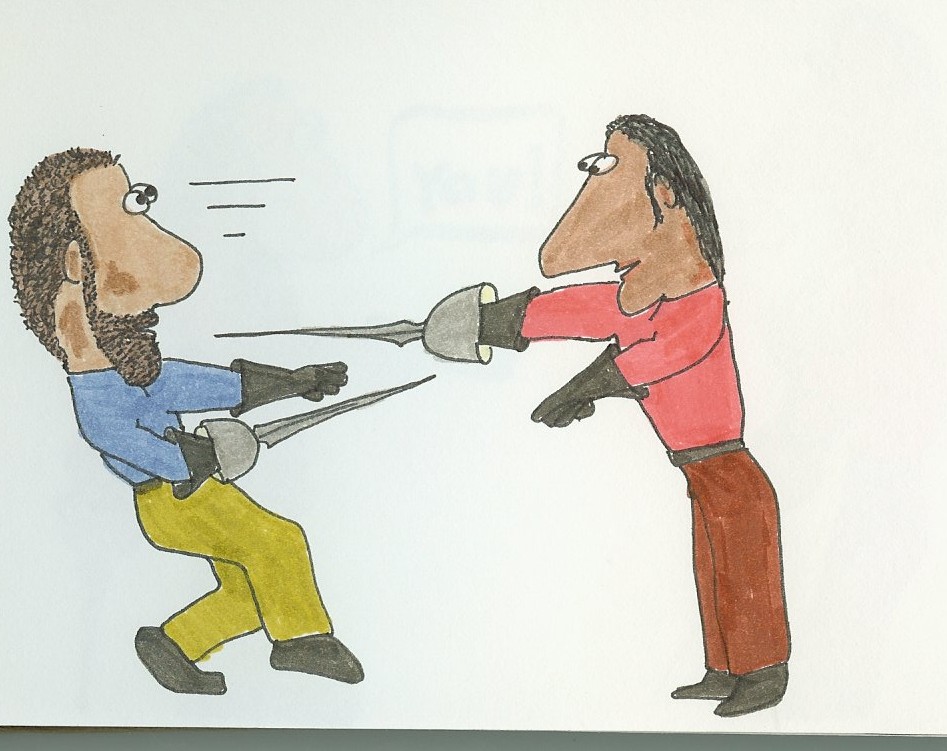
What do you do with this thing?
You stick him with the pointy part.
Different types of blades were used in different ways. Let’s look at a typical one-handed medieval sword. It’s main weapon was its edge, not it’s point. The point wasn’t really used a lot during the middle ages. Armor stopped it. Big heavy swords were used more for smashing and hacking. Still for swordplay know that there are two ends of a sword one with a pommel (heavy enough to counter balance the blade and to smash into things like people’s faces) and the other with our famous point. The cross guard is nice for stopping opposing blades from sliding down and cutting your fingers off but also wonderful for punching into the face. You’ll notice a theme here. Pommel to dross-guard is the hilt. The blade has two parts a forte (or strong) bottom third closest to your cross-guard that is used to parry or block your opponents strikes and a foible (or weak) upper third for cutting your opponents in half. The sharp edge can be on both sides (two true edges) or one in which case the blunt side is called a false edge.
 All swords in one way or another have these parts even if they look different and are different sizes. Some things to remember about sword fights whether they are with medieval swords, renaissance rapiers, small-sword from the 17th century or the American Civil War. You can fight clean or you can fight dirty. If you fight dirty because it’s an ambush on a city street or you’re a soldier in the middle of a large battle, you will use any and or all the parts of your sword to get rid of your opponent(s). If you are fighting a duel you will probably use the blade only but that depends on the upbringing of the combatants (royalty, upper class, training, personality). And different blades are used to do different things – the use of the edge versus the use of the point. To see visually how two very different blades and upbringing can influence how a fight happens see the following two films:
Rob Roy – the final duel between Rob Roy and the English antagonist is a duels between the past (a large two-handed claymore – which is a heavy hacking edged weapon) and the present (a long, thin, pointy small sword that uses the point to do damage). This is choreographed by famous English fight choreographer William Hobbs. These two characters fight the way their personalities tell them to. The fighting is not generic, it is character-based. A good lesson for all writer’s to learn.
Watch any of the fights in Game of Thrones and then watch the scenes of Arya training with Syrio. Two-handed medieval broadswords are weapons of strength while Arya’s Needle is more point than edge (swords from two very different time periods but hey, it’s a fantasy novel so you can do whatever you want!).
A is for Actors On Guard
 Actors On Guard, by Dale Anthony Girard – a great book on the use of the rapier and dagger for stage and screen.
A young man, a kid really, is doing choreography with a rapier, musketeer blade (double wide épée), cup hilt. He does the choreography well with his partner, an experienced actor and stage combat veteran named Dave. Dave is waiting for the kid to start his schtick.
“What’s the real thing like?”
So it begins.
“I bet I could hold my own in a fight with one of these.” The kid’s looking at the blade with confidence.
“Sure you could,” Dave says. He’s tired from almost three hours of fencing choreography – two classes, a beginner’s class and an advanced. This is the advanced class. He’s sweating and perspiring. He worked all night at his seventeen-year proofreading job, graveyard shift. He won’t go to sleep until that evening – if he can last. Its been 24 hours since he slept.
“Seriously, Dave,” the kid says. “Why won’t Joe fence against me?”
“Just stick with the choreography.”
“I bet I could fence against you.” The kid thrusts his blade tip at Dave’s chest.
Dave bats it away with his hand – his leather gloved hand. He’s more awake now. “You’re not a fencer,” he says with just a bit of an edge. “You’re an actor.”
“I’m pretty good,” the kid’s bouncing on the balls of his feet. “I could fence.”
“Joe,” Dave shouts and turns away from the kid. “Kid wants to see what it’s like to fence.”
An older man, probably in his seventies – the decades speaking in the lines of his face – rouses himself from reading the paper at the teacher’s desk. He slaps the newspaper shut and stands up, pushing his chair back. “David,” he shouts back. The rest of the class stops their work on the days choreography to see what’s happening. “Get the kid suited up.” He smooths back his white hair with his fingers and walks over to a locker, pulls out his gear. Dave gets the kid suited up with fencing jacket, mask, glove, competitive sabre. The old man suits up in similar whites. His fits loosely, like he used to fill it out more. Still he wears it with familiarity. He walks past the kid with his helmut under his arm. He turns smartly. Dave has pushed the rest of the class back so they’re all against the wall – out of range. All except the kid. Dave’s put him in the center with the old man.
“We’ll do three touches,” the old man says. “Dave, you’ll judge.” Dave nods and the old man salutes him, the kid, and the audience, then puts on his mask. The kid, a huge smile on his face, copies him.
“Fencers ready?” Dave asks.
The old man nods and says, “Yes, sir.” He is still. His sabre in the line of three.
Dave repeats his question to the kid. The kid is nervously swaying back and forth, the blade moving from side to side.
“Fencers ready? Dave asks him a third time.
He nods finally.
Before the kid can take a step forward the old man slashes his sabre’s edge across his chest. The kid stumbles back a step clutching his chest with his free hand. He rubs it smartly.
Dave hears him breathing shallowly. He knows that one hurt, even with a canvas jacket on.
“Fencers ready?”
The old man cuts the kids arm and the kid grabs the place where he was hit.
“You ok?” Dave asks sweetly.
The kid nods.
Third go.
The old man waits this time. He drops his guard down, inviting the kid in to an open target. The kid attacks. He cuts to the old man’s head. The old man parries easily in five and smacks the kid hard in the head, hard enough to make him stagger back a step and to make the rest of the class gasp.
The old man swipes off his helmut and throws it to Dave. “Carry on,” he says and retreats back to his desk where his paper waits for him.
Dave directs the others to go back to their choreography. He walks up to the kid. “Ready for choreography?” he asks.
The kid nods. He’s still wearing his mask. He still hasn’t moved.
For the A-Z challenge I’ll be talking sword-play, every letter of the alphabet. I love to fence and I love to do the choreography of stage fencing. Outside of playing rugby there’s just about nothing better. As a writer who’s first book has more fencing and stage combat in it than most I hope this unique expertise can help others figure out how to write about the use of the sword whether it’s a small sword, a foil, a broadsword, a bastard sword, or a rapier and dagger. Maybe it’ll help with your next fantasy novel or historical. If you have questions, ask. Otherwise onward tomorrow to B.
Chasing the Moldy Warpe

Reading Railsea by China Miéville is like taking a course in world-building.
I loved this book. It is the kind of book that took me 50 pages to get hooked on but I was intrigued enough from the opening line to get there.
This is the story of a bloodstained boy.
Spectacular opening line.
The reason it was challenging to get into was the same reason it was so fascinating. Miéville creates a world that is told to us by a narrator using a language similar to English but different enough from it that I stumbled through it until I caught its rhythm. I can truthfully say there are a number of things that I read that I truly still do not understand after finishing the book but I don’t care and it in no way took away from the beauty of the book for me. Actually I liked it even more.
Yes, it’s a dystopian world and I like them. Period.
Yes, it has to do with trains and trains are cool.
Yes, it has to do with Moby Dick and the searching for a philosophy or white whale. I liked Moby, even the whale parts.
And yes, the main character is not a superstar, gun and sword wielding hero. He’s pretty mundane, and every-boyish and that’s what makes him so wonderful.
Look at what Miéville does with point of view. It’s 3rd person omniscient through Sham (the bloodstained boy) Ap Soorap’s perspective through the half-way mark and then the narrator tells us it’s time to switch – as if he’s an actor talking to the audience and breaking the 3rd wall. Then the story splits into three stories until they all converge back into Sham. It’s an incredible narrative risk that works spectacularly.
So listen to his narrative. You don’t even need a context:
“No such animal’s crossed our paths,” she said. “Be assured I know now your vehicle’s name, & at the first sign of that beckoning metal in a sinuate mustelid eruchthonous presence, I shall take careful notes of locations. & I shall get you word. On my honour as a captain.”
And then there’s this one from captain Naphi about her “philosophy” the great moldy warpe Mocker-Jack:
“How meanings are evasive. They hate to be parsed. Here again came the cunning of unreason. I was creaking, lost, knowing that the ivory-coloured beast had evaded my harpoon & continued his opaque diggery, resisting close reading & a solution to his mystery. I bellowed, & swore that one day I would submit him to a sharp & bladey interpretation.”.
He uses the symbol & instead of the word and, and then two-thirds into the book explains why he does.
From word choice, to the rhythm of the narrative, to the way characters speak, to the characters themselves. This world is built from top to bottom and bottom to top. Read it as a reader for pleasure. Read it as a writer for a course on world-building. Read it for the bloodstained boy and the moldy warpe.
Eat Sympathetic Gurus
 |
May I be Happy: a memoir of love, yoga and changing my mind, by Cyndi Lee is a memoir about why women hate their bodies and a primer on how to take your yoga practice and use it in your daily life.
Let me put this out there.
I picked this up because Ms. Lee is a yogi who is internationally known for her teachings (yoga and mindfulness meditation) and I’ve read and enjoyed two of her previous books, Yoga Body Buddha Mind (which I loved as a book about yoga and practice and mindfulness) and Om Yoga: a guide to daily practice (which I have used in my own daily practice). I took classes and workshops at her Om yoga studio (before she lost her lease last year and now has a wandering studio) and it was one of the nicest studios I’ve ever been too.
So I think she’s great.
But here’s the thing.
This memoir is written by a dancer, yogi, celebrity with connections to Cyndi Lauper and Jamie Lee Curtis, who travels to India and is in Japan (Tokyo to be exact) during the horrible earthquakes two years ago. She meets famous gurus (because she can). And is obsessed with her body – she has been taught, to just like so many women by our wonderfully patriarchal misogynistic society. She comes from a privileged position at the top of her field so take that into consideration too.
What am I saying?
 |
I tried to read Eat Pray Love twice and both times I couldn’t get more than twenty pages in. Why? Because I just didn’t care about the main character. She was like the three women in Sex and the City – I just didn’t care about them. Okay, okay. I’m a guy so that’s a problem too. It was hard for me to connect but still. The Sarah Jessica Parker character always complained about her life and I found it hard to feel sorry for her. She lived a good life, in a comfortable home, had plenty of money, dated lots of men, had good friends. What was she complaining about? Anyway a sympathetic character helps to keep the attention of this reader. Also, I know, I’m not the target audience for these shows/books so know that too. As a reader I’m in the minority as the book Eat Pray Love is a best seller and people have told me how much they loved it – just not me.
Back to Cyndi Lee before I go off again. I read within the context of my experience. I can’t help that. But I also can learn. That I can help.
 |
So Cyndi… She wrote her memoir about why she hates or why “women” hate their bodies because she does and was taught to. As a “role model” to so many women, she thought it would help other women to explore this issue. Again, I had a hard time during the first part of the book because she is so successful and whining about her squishy parts (her term). This is a woman who does not have visible squishy parts. But she is also dealing with aging, and a mother who is dying, and a husband who has issues – let’s just leave it at that. These aspects of who she is, when taken as a fuller tapestry of who she is were fascinating and brave to speak about. I read on because I wanted to learn more about her. These other stories made her more vulnerable to me, as a reader. She puts herself out there and that is a brave thing to do.
But the most interesting aspect of the book and the main reason I read on was because she used a yogic filter for all of her experiences and that filter was fascinating. I teach in yoga class that we practice in class so that we can take it out into the world. She does this and uses herself as an example. She lives what she teaches and this direct application of yogic philosophy hooked me. Anything else would have been an interesting memoir but this raises it above that status and into another – at least if you’re a yogi or yogini.
One other thing from a writer’s perspective also caught my eye. She leaves out information about her relationship with her husband at a key point of the book which I will not reveal as it’s a spoiler for the memoir. But the absence of information is powerful in how it allows me to see her. Deep pain can be described or it can be inferred. It’s like in a movie when the director has a choice to either show the murder or show a shadow of the murder. Each can be powerful but what is not shown is filled in by the imagination of the reader. Some readers of Cyndi’s memoir may get angry because she leaves this out. As a writer I was fascinated by the story the shadow told me.
Now here’s a question for you. With a little punctuation, how many different meanings can you make with the title of this blog post?


 Lunievicz

