W is for Window Parry

All parries have numbers whether they’re in English, French, Spanish, or Italian. The numbers start low left (1) low right (2), upper right (3), upper left (4), head (5), head (6), middle left (7), middle right (8). Depending on whether you’re fencing or involved in stage combat they numbers may mean slightly different parries and have different positioning. Some parries have cool names too.
If someone strikes at your head the 5 parry, or head protect, is the most natural of parrys. It’s a classic automatic response parry. You raise your hand and your sword creates a line/barrier above your head so you don’t get hit. Now reverse the tip of your blade and your hand positioning (hand goes to the left of your face, palm now facing towards you rather than away from you) and you have a “window” (6 parry) to look out from and a slightly weaker and more awkward parry but an effective one none-the-less. It also sets up a nice back-hand riposte.
Now… take the window (or 6 ) parry and move your hand back to the right, letting the blade “hang” down protecting your right side and back. This is a hanging parry – taken from a cavalry parry (while on horseback). Look for this parry in the fight (link below) from The Count of Monte Cristo. The fight choreographer is the famous William Hobbs. It’s got elements of realism and entertainment – who could ask for more? The movie is pretty good too. Spoiler alert – this is from the ending so if you haven’t seen the movie or don’t know the story… you’ve been warned.
V is for Varvarinski

What happens to the Lefty’s?
Today could be about the volte (evasion from opponents blade by moving the back foot to the right (for righty) or left (for lefty) displacing the body away from the line of attack and creating a new attack line for yourself)… but it’s not. Voltes are cool. But so is Varvarinski.
Nikolai Varvarinski is a fencing master in my book, Open Wounds. Here’s how he describes his philosophy of fencing to the protagonist, Cid Wymann:
“In war I lose count. It is what happen in war.”
“How many in duels?”
“In first duel I place my point in other boy’s chest”— he pointed to the center of his chest—“here. Into heart, I think. Blade go into body—go into body far. I let go of blade—stare at boy. He stare back at me but does not die. I think, why does boy not die? While I think, he put blade in my side and almost kill me.” He lifted up his shirt and showed me a thick puckered scar above his hip.
“You don’t remember?”
“There are many things I not remember.”
“What happened to your fencing school?”
He did not answer for a while, then his hand trembled a moment and he clenched it into a fist. “Enough talk. Now back to work!”
U is for Under Stop-thrust
 If your opponent knows you like to stop thrust and they expect you to counter in the high line (for their head or wrist) you under stop-thrust (really a reverse lunge or pasata soto) and go for the low line or hip or under his arm which if they’re parrying or attacking high goes under their defense. You’ve got to have good flexibility in your groin (okay just think about it – a reverse lunge that is deeper than your regular lunge and supported by your left hand on the ground – I’m thinking groin pull) or it’s gonna hurt. I’ve had a number of friends do this in a stage fight and get up very slowly afterwards. Just saying.
Can you use this in competition? Sure. Is it used often? No. Could it be effective in a real fight? You betcha, but it’s a move you use only once and it either works or you’re probably dead.
Now for a special treat watch this video – The Speed of Fencing. Look for the attacks to the toes, the duck and stop-thrust, the slow motion hits on the wrist and chest, and the graceful beautty of the dance. This is épée.
T is for Traverse

“I thought you said re-verse.”
“I said, Traverse, Traverse!”
Traverse
…is a defensive (mostly) move to the side. It’s an evasion of the blade by displacing your body left or right. In an advance you move forward. In a retreat you move back. In a traverse you move your front foot to the side while you parry. Then you keep going sideways and get the hell out-of-the-way.
Traverse left, parry two.
Traverse right, parry seven.
Attacks with the point tend to be direct, giving fencing a linear feel. The feet are lined up one behind the other and most movement is forward or back. Side-movements like traverses and voltes give transitional rapier and small-sword fighting more dimensions.
Broadsword and rapier fighting can be more circular. The stance is more squared off because it makes it easier to cut and move with a heavier weapon when your feet are both facing forward and your hips are squared to your opponent. Both feet advance.
S is for Stop-thrust
 Okay. I know the image is gross but this is one of the coolest moves in fencing. Of course if you’ve been reading along this month you know that I think there are a lot of cool moves in fencing. Still, the stop-thrust is a great move. As your opponent advances in attack you evade back (by quickly drawing your forward foot back, straightening both legs and leaning forward as you extend your sword arm towards your opponent’s head. You attack into his attack. If you strike before he fully extends you should be able to score.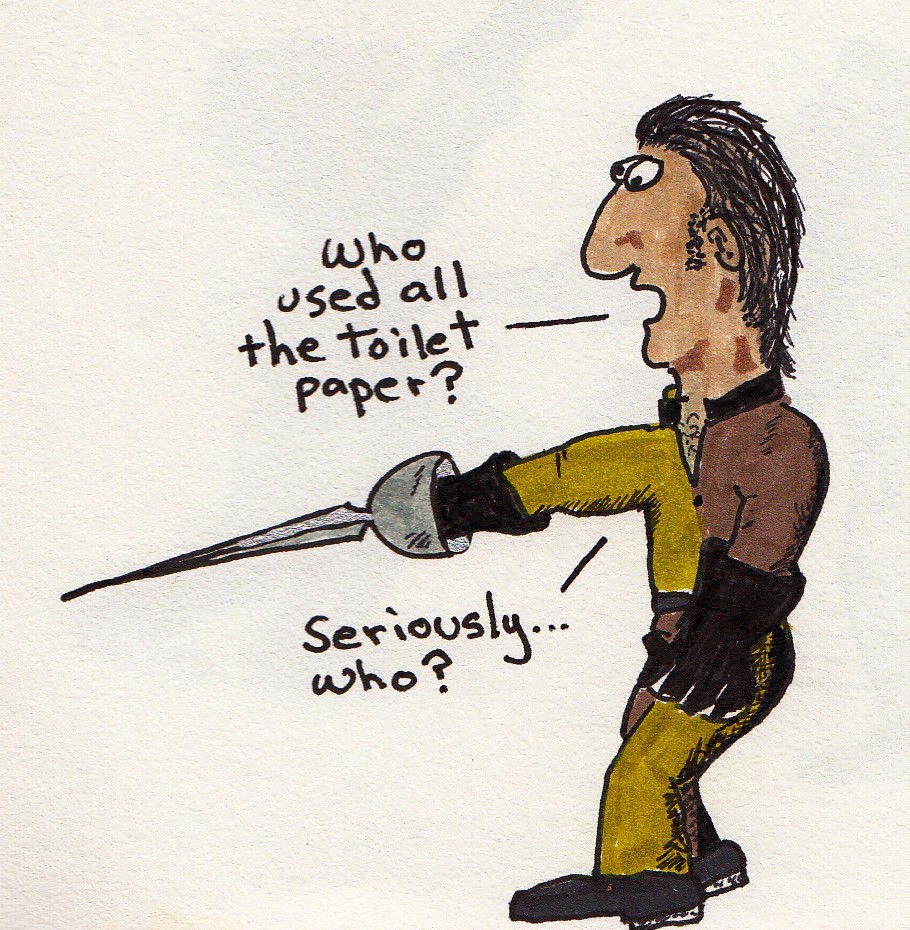


 Lunievicz