M is for Main Gauche
 It’s French for left-handed dagger. Ah the French with their lovely words for articles of mayhem.
Rapier and dagger fights are so cool.
Seriously.
First, they look cool. One of my favorite film fights with rapier and dagger is Errol Flynn in The Adventures of Don Juan, the final fight on the stairs. At the end he throws his sword to the side and says, “The sword is too good for you. You die by the knife!” Then he leaps down onto him. This is a little talked about fight because it comes from a movie that is late in Flynn’s career but if you get the chance to see it you won’t regret it. It’s very tongue in cheek and quite the spectacle. There’s also a fight in a tavern that is wonderful as it’s in an enclosed space. Flynn does all his own work in this film. You can tell because all the shots of him fighting you can see his face rather than shots from behind – when a double is usually in place. As an added bonus see if you can find the clip of the film that comes from Flynn’s The Adventures of Robin Hood. They plucked the scene right out of it and integrated it into this one! Hah.
Second is that the fight with a main gauche moves very fast. The reason for this is that when you parry with your dagger you can, at the same time attack with your sword. This cuts into the time of your opponents attack. Instead of a beat of tick tack tick tack you get ticktackticktack. It can look just ferocious. When choreographed it is much more complicated and stage combatants have to really be aware of where the blades are and what each hand is doing – for the more experienced combatants only. You can also attack with the main gauche as an added bonus in case you close the distance or want to get someone away from you who is too close.
Third and finally, there is something about a dagger, of any sort that just seems dangerous. A knife expert told me once that if anyone ever pulled a knife on him he would get the hell away as fast as he could. Why? Because in knife fights fatalities are common. You’re just too close to miss. So good advice. As they say in Monty Python and the Holy Grail. Run away!

L is for Lunge

The Lunge
Sometimes I spell it lung or lungee. I don’t know why. Perhaps because it’s late and it’s been a long week. Perhaps you know what I mean.
A lunge is an attack that elongates the body and subsequently the blade towards your opponent with the hope of skewering him. Okay I’m feeling a little aggressive so we’ll work with that. From en guarde you extent your sword arm then the front foot kicks forward and up while the back leg straightens advancing your blade toward your opponent with the hope of skewering him. I know I said that twice but the image stays with me.

The kick is up, the lunge is Good!
There are two cool ways to practice lunging. One is to have someone stand in front of you just out of reach with a glove in their hand. From en guarde you have to wait until the glove drops and then lunge and try to grab the glove before it hits the ground. The second way is to place a quarter under the heel of your front foot and when you kick your front foot forward and up you have to lift your toes first and push hard with the heel to send the quarter skimming forward. This practices the explosive part of the move.
The lunge is a quick and efficient attack that can use all kinds of combination attacks with it including deceptions of the blade, feints, beats, and glissades. Usually books talk about three types of lunges, the demi (or short) lunge, the grand lunge (it is what it sounds like), and the standing or stationary lunge. You can throw in the passato sotto or rear lunge (which is really an evasion – a duck) also as a personal favorite. In the passato sotto rather than lunging with the front foot kicking forward, you duck and kick your back leg back, extend your sword arm while you bring your free hand to the floor for balance. Your opponent runs on to your blade – always helpful.
Did they lunge in medieval times with long swords and broadswords? Nope. They would use the point only after their edges were dull and they got tired of trying to crack each other’s metal shells and started trying to stick the point into the creases between the plates in the throat and the underarm. Who needs a lunge for that?
Besides the lunge wasn’t even invented until the 16th century, when they figured out that the point of the blade moves faster than the edge. Think about it. It does. And you can see a cut coming but just looking at the point it’s harder to figure out distance or target to defend against. Oh and the Italians invented the lunge. Capo Ferro’s prints are the first to document it. Gotta love that guy.
K is for Knuckle Bow
 The knuckle bow is part of the sword guard that sweeps from the hilt to the pommel in a bow shape offering protection to the sword hand.
Competitive sabres have them and many rapiers did. Not only great for protecting the hand but great for in-fighting also – smashing into the face especially. The pommel is great for that also as is the cross guard. You can also (as a neat trick) reverse your sword, holding the blade with both hands, one hand on the foible and one on the forte. Then use the parts of the hilt and grip as a weapon. Nasty stuff. Not taught on the lawns of the great families but in the dark alleys where the smell of brandy and whiskey is strong. That and urine. I had to add that in. Couldn’t help myself.

- The Masked Man
J is for Joust

Don’t Ask. Don’t Ask.
I know what you’re thinking. Jousting is not swordplay. It’s two men on horses in armor trying to knock each other off with a lance.
It is that.
But it also was so much more. Swordplay in medieval times was more brawn than finesse. Armor was heavy and so were the swords and shields. Originally a joust could be a battle on horse, a grand melee or single combat on foot. On foot is could be with pole-axe, axe, dagger, or… the sword. By The Sword by Richard Cohen is one of my favorite books on combat with the sword and he’s got a whole chapter 0n this type of combat.
On the melee, “… these jousts were condemned by the church for their high casualty rates.”
On single combat, “…the use of heavy armor and heavy weapons allowed only simple movements, forcing contestants to concentrate on one blow at a time, so that complicated phrases were impossible… Only when a shield was so cut up as to be useless were the swords themselves used for parrying, as edge-to-edge clashes were mutually damaging.”
I went to visit a Society for Creative Anachronism group a few times where they roleplay medieval life including fights with swords. I fought twice. They use rattan taped up with duct-tape – think getting hit with a two-by-four only it’s lighter so it moves a little faster. I wore leather armor and a full steel covers the whole head like the black knight in Monty Python and The Holy Grail, helmet, hand-made by a friend. They calibrated me for the fight (so I would know what a death-blow was vs a glancing blow or arm-cutting-off blow) by wacking me in the head with their swords three times. “This is a death blow.” Wack. “Let’s do that again.” Wack. “Once more so we know you got it.” Wack. My head was ringing. Then they put a sword in my hand and gave me a shield (heavy) and we went at it. In a matter of seconds I had been hacked in the legs and wacked in the head. Death-blow. I tried again and lasted about two minutes. It was very humbling. All my opponent did was smash into me with his shield, and wack me with sword blows to my head – very very fast, repeatedly. O as fast as he could go with all that armor on. Okay it seemed fast to me, even it wasn’t. Hell, I had no idea what I was doing.
I still had fun.
I would do it again.
Wouldn’t you?
I is for Imbroccata
It’s only a flesh wound.
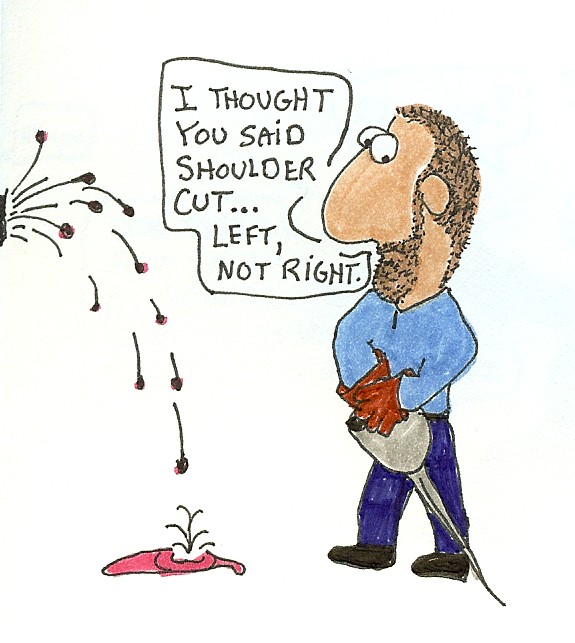
Imbroccata is an Italian word for a downward thrust, generally delivered from the right side with the hand pronated over one’s opponent’s sword arm. Your sword hand is higher than your shoulder and the point of your sword is angled down. – Actors On guard by Dale Anthony Girard. It looks vicious in a stage fight and in competition I find it makes my opponents hesitate (as in what the hell is he trying to do now?).
I love all the Italian words for the different fencing moves. The opposite of the imbroccata is the stoccata (attacking from the bottom up under the opponent’s sword arm). Mandritti are cuts from the right side. Botta Dritta is the straight thrust. Botta longa is the lunge. Stramazone is a slicing or cutting blow made with the point/tip of the sword. Mandritti Squalembrato is a cut from the right side oblique and downward attack. Volte is a specialized foot movement to avoid a thrust – nothing to do with a battery. And finally Botta segrete or the secret attack – is the secret attack that only a few fencing masters know of that no one can defend against.
The language of fencing whether it’s in English, Italian, or French, is a language of textures, colors, aggression, and heavy breathing. Yes it’s very much a language of sex in addition to one of violence.
The rest I’ll leave to your imagination.


 Lunievicz