P is for Pommel

French for little apple. It is the metal fixture that locks together the different parts of the weapon and acts as a counterbalance to the blade. It also means to strike, beat, bash, hit with the pommel.
If you want to see how well-balanced a weapon is try to find the place you can rest the weapon on two extended fingers. It should balance a little past the hilt and the ricasso (the part of the blade just past the hilt that is not sharp and begins the forte). A well-balanced sword will swing easily and be controlled easily. It will feel right, not tip-heavy.
Pommels can be plain or ornate, or somewhere in-between – just like your characters.
O is for Open Invitation
I have an itch. Anyone… anyone… a little help?
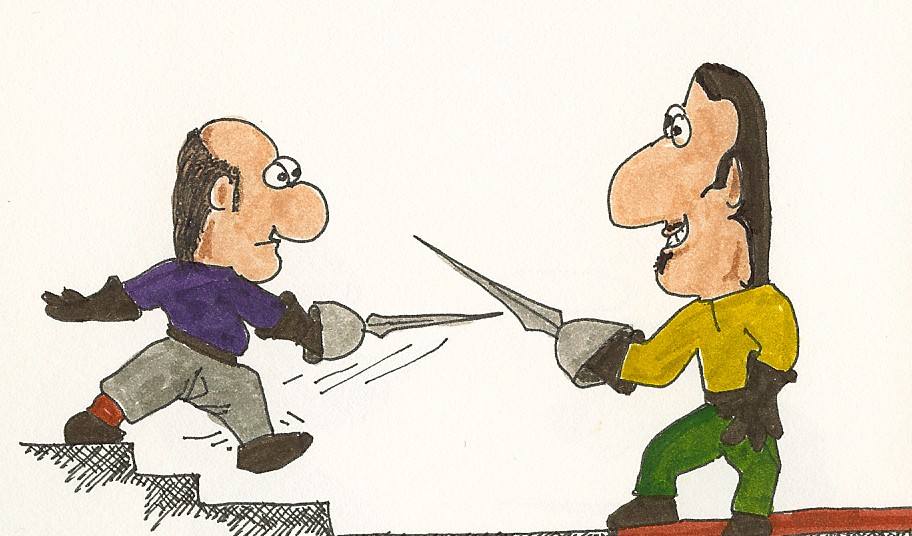
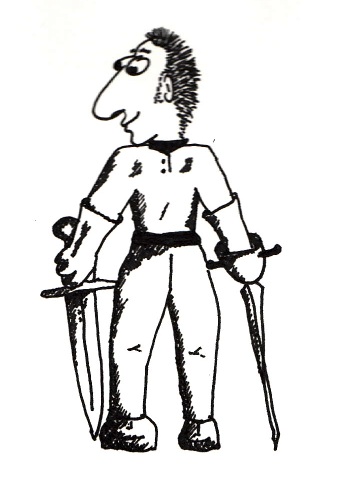
Open Invitation is a deliberate placement of the blade which exposes the entire body, intended to draw an attack from an opponent. This is a tactic a more experienced fencer usually takes against an opponent to throw them off their game or to try and make them make a mistake by making an obvious or rash move.
For example, I was fencing Coach Wrak (that’s really his name) in his backyard salle (fencing studio) where swords of all sorts hang from the walls in addition to his wife’s clothing, luggage, various exercise machines in various modes of disrepair, ancient torture devises (a cement brick with a rope tied to it and attached to a dowel that you hold in your hands and using wrist and forearm power tried to roll up), books (of which mine is one), stacks of fencing equipment, and a greenhouse looking ceiling and three walls, one of which is painted as a school mural with now curling strips of paint hanging off it. So… I was fencing Coach Wrak last Friday night and I was doing well, getting touches off his wrist and arm (we were fencing épée and the whole body is a target), scoring twice on straight attacks and once off of a deceive – and then there was the stop-thrust to the head that always cashes in for morale points. I was feeling cocky and he was getting a little frustrated – at least that’s how I’m reading it looking back. Then he gave me the open invitation – he relaxed a little in his on guard, opened his arms to show me his whole body was unprotected, and smiled at me, inviting me to attack.
I got nervous.
I attacked and stopped half-way into the thrust at his chest, which he’d left open. He waited, didn’t even defend – nerves of steel. The corner of his lip curled up. “What are you going to do now?” he asked, his Polish accent thick.
“Good question,” I answered and lunged straight for his chest.
He parried four.
I deceived to three.
He brought his blade back and caught me in three, riposte to my chest – touché.
This happened three more times. He left himself open but he was far from defenseless. I did not score touches again until he changed his guard.
He got into my head with his open invitation and I couldn’t get him out.
I couldn’t think of what to do because I could do anything. Too much freedom gave me brain freeze. He set a trap and I fell into it.
Wait until next week.
As a writer this kind of positioning is a wonderful opportunity to show character through choice of guard (or the way you hold your blade in on guard – know that every guard shuts off a line of attack and opens up another. Only the open invitation leaves them all open.). What does Coach Wrak’s choice speak to of his personality, confidence, skill level? What do my reactions and choices show of me. Okay, let’s not go there. I’m neurotic enough as it is. Anyway, you get the idea…
N is for Nee
 We are the knights who saaaaaaaay… nee. What does this have to do with fencing? Well… they are knights…
M is for Main Gauche
 It’s French for left-handed dagger. Ah the French with their lovely words for articles of mayhem.
Rapier and dagger fights are so cool.
Seriously.
First, they look cool. One of my favorite film fights with rapier and dagger is Errol Flynn in The Adventures of Don Juan, the final fight on the stairs. At the end he throws his sword to the side and says, “The sword is too good for you. You die by the knife!” Then he leaps down onto him. This is a little talked about fight because it comes from a movie that is late in Flynn’s career but if you get the chance to see it you won’t regret it. It’s very tongue in cheek and quite the spectacle. There’s also a fight in a tavern that is wonderful as it’s in an enclosed space. Flynn does all his own work in this film. You can tell because all the shots of him fighting you can see his face rather than shots from behind – when a double is usually in place. As an added bonus see if you can find the clip of the film that comes from Flynn’s The Adventures of Robin Hood. They plucked the scene right out of it and integrated it into this one! Hah.
Second is that the fight with a main gauche moves very fast. The reason for this is that when you parry with your dagger you can, at the same time attack with your sword. This cuts into the time of your opponents attack. Instead of a beat of tick tack tick tack you get ticktackticktack. It can look just ferocious. When choreographed it is much more complicated and stage combatants have to really be aware of where the blades are and what each hand is doing – for the more experienced combatants only. You can also attack with the main gauche as an added bonus in case you close the distance or want to get someone away from you who is too close.
Third and finally, there is something about a dagger, of any sort that just seems dangerous. A knife expert told me once that if anyone ever pulled a knife on him he would get the hell away as fast as he could. Why? Because in knife fights fatalities are common. You’re just too close to miss. So good advice. As they say in Monty Python and the Holy Grail. Run away!

L is for Lunge

The Lunge
Sometimes I spell it lung or lungee. I don’t know why. Perhaps because it’s late and it’s been a long week. Perhaps you know what I mean.
A lunge is an attack that elongates the body and subsequently the blade towards your opponent with the hope of skewering him. Okay I’m feeling a little aggressive so we’ll work with that. From en guarde you extent your sword arm then the front foot kicks forward and up while the back leg straightens advancing your blade toward your opponent with the hope of skewering him. I know I said that twice but the image stays with me.

The kick is up, the lunge is Good!
There are two cool ways to practice lunging. One is to have someone stand in front of you just out of reach with a glove in their hand. From en guarde you have to wait until the glove drops and then lunge and try to grab the glove before it hits the ground. The second way is to place a quarter under the heel of your front foot and when you kick your front foot forward and up you have to lift your toes first and push hard with the heel to send the quarter skimming forward. This practices the explosive part of the move.
The lunge is a quick and efficient attack that can use all kinds of combination attacks with it including deceptions of the blade, feints, beats, and glissades. Usually books talk about three types of lunges, the demi (or short) lunge, the grand lunge (it is what it sounds like), and the standing or stationary lunge. You can throw in the passato sotto or rear lunge (which is really an evasion – a duck) also as a personal favorite. In the passato sotto rather than lunging with the front foot kicking forward, you duck and kick your back leg back, extend your sword arm while you bring your free hand to the floor for balance. Your opponent runs on to your blade – always helpful.
Did they lunge in medieval times with long swords and broadswords? Nope. They would use the point only after their edges were dull and they got tired of trying to crack each other’s metal shells and started trying to stick the point into the creases between the plates in the throat and the underarm. Who needs a lunge for that?
Besides the lunge wasn’t even invented until the 16th century, when they figured out that the point of the blade moves faster than the edge. Think about it. It does. And you can see a cut coming but just looking at the point it’s harder to figure out distance or target to defend against. Oh and the Italians invented the lunge. Capo Ferro’s prints are the first to document it. Gotta love that guy.


 Lunievicz