Crack for Writers
Goodreads is like crack for writers.
I’m serious.
It’s not like crack for readers, but it is for writer’s – at least it is for me.
I didn’t do Goodreads until my book was going to be published. Then I got on, got in, and started being a part of the Goodreads world. I smoked the pipe. I joined the YA Historical Novels group. I settled into the background after a short comment or two and didn’t even mention my book. I played by the rules.
Then I got my first review and it showed up on Goodreads. It was five stars.
That’s when I knew I was in trouble. First I only looked at the site a few times a week. But when my book came out and the list of people reading Open Wounds or who put it on their book shelf grew and more reviews came in – I started checking ever y day.
Then it was twice a day – every day.
I started noticing the details about the site. I checked to see who was new on the to be read list. Did I know them? I got an adrenaline surge every time a new person was added to the list. I checked that number first, then checked the date of the most recent addition to the list. And I kept waiting for more reviews.
Five star reviews made me feel euphoric. It would last a few hours. Then I developed some tolerance and it lasted less. Now I needed them just to feel normal.
Four stars send me right into withdrawal.
One reviewer said she wanted to give me four and a half stars but since Goodreads only allowed full stars she gave me four. Why didn’t she just give me five? Why can’t the cup be half full and not half empty? Doesn’t she know that reviews are crack for writers and no matter what anybody says, we live and die by them? Is it just me?
I tried to quit. I tried to stop looking at Goodreads, just for a couple of days. So I turned to Amazon. Amazon was like methadone, only it didn’t work as well because methadone is for opiates and crack is a stimulant. I should have known better. I do drug prevention work in my day job.
Goodreads called to me.
So I went back. But this time I think I have it more under control. I’m taking a harm reduction approach. I took it off my toolbar bookmark. I went on to write reviews of books I’ve read so I keep the site in a positive light. I tell myself the number of stars isn’t important. I keep myself busy. I occupy my mind.
Then I check it… just… one… more… time…
Amazon, Goodreads, and Subsidiary Rights, Oh my!
I don’t do well on labor day. See this post on my Zen Dadd-itto blog for the reason why. So I didn’t post yesterday or the day before.
But today I’ll finish up with groups three and four, business people and reviewers.
Group three is made up of editors, publishers, media folks (movies, audio, book club, the same folks in other countries) who might take an interest and buy subsidiary rights. These are paperback, audio, e-book, world rights, movie rights, and book clubs. I might be missing one or two but you get the idea. How do you reach these folks? Either through your agent (if you have one – hence the importance of having an agent) if you retain the rights, or the publisher if they retain the rights. How else can you influence these folks? You can sell books. A lot of books. Print runs these days for a small press and even medium or large presses first authors can be 2-3,000 copies hard cover. If you want to get noticed the first thing to do is sell through your first print run, then try to hit the 5,000 mark and then the 10,000 mark. That will get you some notice. Dewey Lambdin, a bestselling author of a naval series called the Alan Lewrie Naval Series (one of my favorite historical novel series) told me he was told by an editor about his fifth or sixth book (he’s got over a dozen by now) that he needed to hit the 50,000 mark to get noticed.
Let’s start with the number 10,000. It’s a big number. You have to reach a lot of people and convince them to buy your book in order to reach 10,000. Still, if you get there, selling a second novel will be that much easier as will selling subsidiary rights. Which, once sold, help you sell more copies of your book. It’s synergy – as far as I can tell.
Group four is reviewers. Reviewers reach a lot of people. I’ll say that again. Reviewers reach a lot of people. Good reviews are important but getting reviewed is even more important. Internet reviews by bloggers who have 100 or 300 or 1000 followers get you visibility in different parts of the country that you wouldn’t get in any other way. It can also start word of mouth from blog to blog. You can reach people fast and with a review with information about your book that some percentage of people will hopefully use to buy it. Other good places to be reviewed include Amazon (because it’s used as a barometer of how well your book is doing and people from group three browse it to see how books are doing.) and Goodreads. (By the way if you haven’t reviewed Open wounds on either Amazon or Goodreads please do – I can use all the reviews I can get!). Goodreads is another story worthy of a blog entry all by itself. Andrew Smith recently commented on his relationship with Goodreads and I have some similar and lively things to say about my relationship with it too. Still, readers and group three media and group two booksellers also look at Goodreads so it’s worth getting on and asking people you know who read the book to post there in addition to Amazon. It’s all about visibility. In order to sell 10,000 copies of your book you probably have to reach ten times that number of people (100,000). I’m only guessing. It could be more or less depending on how targeted your market is.
But what does it all mean? It means I’m overwhelmed as all hell with the odds against selling well and the tremendous amount of work that needs to be done to sell books. In other words when the writing is done and the book has been bought – it’s not over. If anything, a new kind of work has just begun.
From Ship Breaker to the Lightning Thief
I spent a few hours yesterday writing follow-up emails to all the store owners and booksellers I met on the road trip. There were about a dozen from that many indi bookstores. So here’s what I’ve figured out about this whole marketing thing. If I’m going to sell my books I have to reach four different groups.
The first group is readers. I have to let potential readers know about my book, that it exists. The internet is a wonderful tool for this as are bookstores. You would think reaching all the people who are potential readers would be easy but… it’s not. You have to get their attention and give them a reason to look at and buy your book as opposed to the hundreds of others staring at them in the bookstore or on the online page. Which brings us to group number two.
The second group is booksellers. They can be in bookstores or they can be on the internet. But the internet acts as a bookseller all by itself only it’s harder to figure out. On Amazon there are sections like, “People who bought this book also bought the following…” This is cool because I can see that people who bought my book also bought Forever by Maggie Stiefvater, Ship Breaker by Paolo Bacigalupi, and once but only once, Rick Riordan’s Lightning Thief. But how does this play out for new people finding my book? Hopefully I’m showing up on other book’s lists. Still, it’s not like you’re in a store and ask a bookseller what they read lately and like or if they can recommend a book for boys, or a new historical novel, or a book with sword fights and suspense with a touch, just a touch of family drama. Which is why as cool and helpful as the internet is, reaching bricks and mortar stores and developing relationships with bookstore owners and sellers is so important. It’s slower, but it builds over time. So far I’ve been to 23 stores (seventeen of which are independent bookstores), in nine states, and I’m just getting to my hometown, NYC this month.
As they say, people can’t buy your book if they can’t find it. It’s available over the internet, yes. But in bookstores… I’m working on that one store at a time.
Discussion of the third group, the business (agents, publishers, film, audio, and all the possible buyers of subsidiary rights) people, and fourth group, reviewers, tomorrow.
Reviews and Interviews
I’ve been busy these last two weeks. Two weeks ago I was in DC and in addition to presenting at a National Association for Drug Court Professionals conference on Teambuilding and LGBT sensitivity issues had the chance to fence with the DC Fencers club (more on that in another entry) and visited a few bookstores to talk about Open Wounds. I’ve also been doing a lot of interviews – each different in its own way and worth checking out to find out how Open Wounds and its cast of characters came about. I’m going to list them below and give you some background on each.
Two local papers start things off:
The Queens Tribune – Jason Cohen did a piece on me titled Renaissance Man (I’m getting a swelled head already) that is only available in print and not on the internet – so no link. But it’s been fun having some neighbors come up to me and tell me, “I didn’t know you wrote a book!” I didn’t know so many people I knew read the Queens Tribune!
The Queens Courier – Salimah Khoj a wrote a nice piece on their online magazine called Jackson Heights Author Finds Inspiration in Childhood. We had to phone interviews and some written responses in order to get this one down and I think she did a great job.
Followed by two blog interviews:
Nikki Meiggs’ Wicked Awesome Books book blog just reviewed Open Wounds and today put out the second of two parts of an interview (part 1 and part 2) we did together. She has a contest open until August 16th – simply comment on part 2 by answering this question: If you could live in any time period or historical event what would it be and why? She’s giving a free signed copy of Open Wounds to the winner! I met Nikki at BEA in the late spring and she has a great blog on YA books and really loves books. I also love the title of her website – who wouldn’t?
Cynthia Leitich Smith blog Cynsations also just put up an interview called New Voice: Joseph Lunievicz on Open Wounds. What’s interesting about Cynthia’s interview were the questions she asked. There were easily thirty different questions from various categories and I was able to choose two, and only two, to respond to. These are different from any other interview questions and I found them challenging and interesting to answer. She also did a wonderful job with pictures to complement the interview of books I mentioned and supplemental posts I have out on other sites.
And one review…
There’s also a short review of Open Wounds by Jodi Reszotaarski on her blog Book Eater – A novel test kitchen. She’s a high school media specialist in Lake County, Ohio. Thanks, Jodi for the great review!
Next up some fencing stories.
Book Review: Return to Exile – E.J.Patten
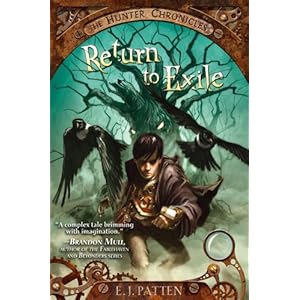 This book was given to me at BEA back at the end of May… for my son. He read it, loved it, and told me I had to read it. This is E.J.Patten’s debut novel and it is quite the rubix cube of a novel. It is also a lot of fun. My son is 9 and an advanced reader so my guess is this is an 11 and up book – though easily enjoyed by adults – all those who enjoyed Rick Riordan’s work and Suzanne Collins’ Gregor the Overlander books – though Patten’s book is for older readers – is more sophisticated in plot and in fright factors – will enjoy Patten’s work.
So who is this guy Patten? Take a look at his website for some interesting background on him and on this first book in his series – what is called The Hunter Chronicles.
Here’s the synopsis from Goodreads:
Eleven years ago, a shattered band of ancient hunters captured an unimaginable evil and Phineas T. Pimiscule rescued his nephew, Sky, from the wreckage of that great battle. For eleven years, Sky Weathers has studied traps, puzzles, science, and the secret lore of the Hunters of Legend, believing it all a game. For eleven years, Sky and his family have hidden from dark enemies while, unbeknownst to Sky, his uncle Phineas sacrificed everything to protect them. For eleven years, Sky Weathers has known nothing of that day. But on the eve of Sky’s twelfth birthday and his family’s long-awaited return to Exile, everything changes. Phineas has disappeared, and Sky finds himself forced to confront the mysterious secrets he’s denied for so long: why did his family leave Exile on that day so long ago? What, exactly, has Phineas been preparing him for? And, the biggest mystery of all, who is Sky really and why does everyone want to kill him?!
What came to mind for me immediately as I began this book was how unique and different the world that Patten built is. It is part Lovecraft with dark, dark, frightening monsters who are shapeshifters and tentacled, and razor sharp toothed with mouths on their heads and caps to cover them – part Solomon Kane from Robert E. Howard (the author of Conan), and all bizarre. Man these monsters with names like Whisper, Gnomen, Wargarou, Shadow Wargs, are creepy and imaginative and scary and they surround the main character, Sky Weathers, who is likeable and always one step behind the plot which is one giant puzzle/trap. His mentor, Phineas T Pimiscule, is a wonderful creation and worthy of a book all by himself. The theme of puzzles and traps is fascinating and one of the things that intrigued my son about the book and also intrigued me. I was constantly trying to figure out what would happen next and was always surprised by the shifting landscape and characters. This is a world of shapeshifters and darkness.
Check out the opening line – always a key element in book selection for me:
Phineas T. Pimiscule was not what you’d call an “attractive” man.
This is a line that begs you to read on.
And this is a book you must also pay attention to. Half the fun was trying to guess what the solutions to the puzzles were just as Sky was. I especially appreciated the world-building done by Patten – epic in scope, logical and consistent in tone, and thought-provoking. I enjoyed having characters that were evil and good, monsters that were sometimes both at the same time, and good guys who could also be bad. Sky’s world is not made of simple black and white.
Do I have complaints about the book? Patten’s use of simile was a bit much with less, for me as a reader, being more. But this is a small thing compared to the success of the larger scope of the book and the craft of world-building he has demonstrated. The ending is just beautiful. I won’t spoil it but I will tell you it reads like the perfect ending to a pulp serial – ominous, dark, and bookended by razor-sharp tooth and suction cupped tentacle.


 Lunievicz