M is for Molṑn labé! (Come take them!)
 Molṑn labé!
“Come take [them]!”
King Leonidas of Sparta says this in response to King Xerxes of Persia’s demand that the Greek army lay down their arms before the Battle of Thermopylae. Tens of thousands against 300 and they say, “Come take them!” What were they, out of their minds?
The movie 300 (see it if you haven’t because it’s awesome) is one of the most chest-thumping, testosterone filled films I’ve seen in the last year. Maybe I don’t see many chest-thumpers or maybe it is just that visually stunning (it is). Or maybe it’s the classic story that grabs me in which 300 come-back-victorious-or-on-your-shield Spartans hold off a swarm of Persians at the small pass of Thermopylae so that their armies back home can organize. They buy time now for victory later. And… spoiler here … they all die in the process. It’s brutal. But the dialog is just amazingly chest-thumping. There’s so much testosterone in this film it is overflowing.
What’s fascinating to me is how caught up I was in the characters, the father and son, the two friends who are like brothers (they are all like brothers), the king who willingly sacrifices himself and his warriors for the greater good of his country, and the cripple who wants so bad to be a soldier and betrays them all.
The reviews were mediocre of this film when it came out so I did not see it until recently. Everyone said it was visually spectacular but that the story was weak. I didn’t see that at all. I saw tremendous violence surrounding characters, hard as nails, that I cared for. That’s what story is all about. Characters you care about placed in danger in some way that they have to somehow get out of or through or around – even if they do not survive. Extreme, yes, in this case, but also, compelling.
L is for Láthe biṓsas (Live hidden)
 I might be stretching here but we’re almost half way through the alphabet and I’m still talking Greek so there’s something to say for that.
Live hidden is from Epicurus. He said this because he believed that politics troubled men and didn’t allow them to reach inner peace. If you’re watching the republican primary or have Barak Obama’s campaign on your radar perhaps you’ll agree. It’s like watching a train wreck and not exactly good for serenity now. So Epicurus suggested that everybody should live “Hidden” far from cities, not even considering a political career. I’m not saying everyone should be anti-epicurian on this political career thing but I do wonder how this works in my writing.
Once at a writer’s group (a long time ago in a galaxy far far away) I had the group take parts from a play I was writing that took place in Rome just about the time of Julius Caesar’s death at the hands of Brutus. I know. It doesn’t sound funny at all but I was taking a side-show perspective of a laundromat far down the block from where Marc Antony makes his speech and they were translating it back through the crowd by whispered word of mouth so that the folks in the cheap seats got a garbled message. Anyway, it was comedy. Slapstick. Pratfalls. One of the writers commented to me during the feedback round, “I can’t wait to see what you do with this piece when you give it the deeper meaning I know you’re striving for.”
There was no deeper meaning.
I was just trying to be funny.
Maybe it was the Caesar thing that created high expectations – or the echo of Shakespeare’s words. I don’t know but I nodded and said, “Yes… a deeper meaning.” And of course wondered, did I have to have a deeper meaning and should I just give up and throw the play away before someone got hurt?
I know, if I’m honest, I write fiction based on my values and life experiences – where else can my ideas come from? But these are tempered by the needs of my characters. They are filtered and so they become both mine and theirs. Some represent me and some don’t (or better not – but what if they do?). I set out to tell stories. I don’t usually set out to be engaged in politics. But if I do, the ideas will certainly be welcomed into the fracas.
Did you know that Roman laundries used urine as bleach? It gets the whites whiter. Now what kind of political statement is that? What’s the deeper meaning in pee?
What do you do with your political ideas? Do they work deliberately into your stories or do they… live hidden?
K is for Knossos
 Knossos is a city veiled in myth, mystery and archeological digs. It symbolizes the capital of Crete from long ago and is the site of King Minos’ realm(Mr. Goldfinger himself), and the infamous Labyrinth – designed by the legendary artificer Daedalus (father to Icarus) – and the Minotaur that prowled its corridors – eventually slain by the Athenian hero Theseus. The site of the dig is called Heraklion – which sounds bone-cracking to me – and sits at a port city on the north coast of Crete.
Everywhere you look in ancient Greece you have the hero’s journey repeated again and again and each story seems more colorful than the last. But for Knossos it’s all about the place.
Island, palace, throne room, Labyrinth of stone walls, the smell of decaying flesh pushed away by a breeze from the nearby Mediterranean Sea. The sun hot, making you sweat, the dust thick in the mid-day, the smell of your perspiration a cloak you can not get rid of so you get used to it.
Sights, smells, sounds, textures. They all come together to make place an element in a story. In my novel Open Wounds, some reviewers have said that New York City of the 1930’s and 1940’s is a character in the book, just as alive and breathing as the protagonist, Cid Wymann. One breathes life into the other.
How important is place in your writing?
Do writer’s perspire in your electronic dreams?
J is for Jason (and the Argonauts)
 The 1963 version of Jason and the Argonauts has an army of skeletons attack Jason and his sturdy argonaut crew. The skeletons area a creation of special effects wizard Ray Harryhausen. I saw this movie as a kid and it made my jaw drop open in absolute amazement. They looked real – still better than any CGI effects you can see today. They made the movie come to life. They made the whole hero’s journey work for me even though the lead, Todd Armstrong, was far from charismatic as Jason.
And the hero’s journey is what Jason is all about. Here’s a short-hand version of his life:
Jason is related to Odysseus (the hero of the Odyssey – not a bad lineage), tossed out of his kingdom by his uncle Pelion, is raised by the centaur Chiron, gets helped by Hera (always problematic), becomes the man with one sandal (kind of like the man with no name from a spaghetti western), goes on a quest for the golden fleece (just like Percy Jackson), gathers a band of burly argonauts including Heracles, Theseus, and the poet Orpheus (why is a poet on this adventure?), gets help from Athena (I thought she only helped women?), meets Medea and falls in love with her, plows a field with two fire-breathing bulls (one of which was in heat), sows the field with the teeth of a dragon (these become the skeletons in the movie!), snatches the golden fleece (snatches is a word that needs to get used more), marries Medea, takes his kingdom back from Pelion by tricking Pelion’s daughters into cutting him up into little bits and eating him (talk about issues for therapy) – take a breath from this long run-on sentence – has children of his own then falls in love with another woman (he can’t keep his you-know-what in his loin cloth), has Medea leave him after she in a fit of anger kills off all their own children, and finally ends up alone and lonely and kills himself by dropping off the end of his old ship the Argo. Whew. The hero’s journey.
Things need to happen to your hero/heroine. Whether it’s the journey to the corner drugstore, or the journey inside her head. Hero’s get chased by skeletons, big and small, real and imaginary and like Jason, they conquer or get conquered, grow, learn, or get dashed against the harsh realities of their existence. What is your hero’s journey like?
I can tell you this… mine will have white boned creatures with round shields and scimitars in there somewhere.
I is for Icarus
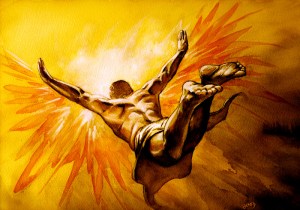 Icarus is a cautionary tale. Father Daedalus builds wings of feathers and wax to fly with – warns son, don’t go too close to the sun. Son flies too close and falls to the earth after his wings melt. Usually connected to the term hubris. Also connected to the term Icarus Complex (Psychiatry – A constellation of mental conflicts, the degree of which reflects the imbalance between a person’s desire for success, achievement, or material goods, and the ability to achieve those goals; the greater the gap between the idealized goal and reality, the greater the likelihood of failure.)
Sometimes I feel writers, all of us, are like Icarus, testing out our wings of wax and feathers, flying as close to sun as we can. The difference is our failures (those manuscripts we gave up on, or move on from, or let go of because we realized they just weren’t good enough – I have three of them that sit in my closet staring at me when I open the door and wondering if, when, I will go back to them, please, they say – take me out again!) we learn from and grow stronger from because we tried to see if they would fly. Testing out my work in the market place is the way for me to see if the wings are strong enough this time. If not, perhaps I just need to go back to the workshop and build better wings?
Notice when you’ve built better wings. It will carry you through the times the wings aren’t built good enough, cushion you on the nasty falls.


 Lunievicz