Broads and Johnny D.

One of the first writers I read as a writer, and not just as a reader was John D. McDonald – and specifically his Travis McGee private eye series. I found his books in the Peace Corps library in Honduras. Now you have to picture the volunteer’s library as a large shelf of mostly paperbacks next to the nurses office where you get shot in the but with gamma globulin twice a year. Always some interesting sounds coming out of that place. The couches outside in the courtyard were where you waited for your turn to get shot. The bookcase was next to couch furthest away from the nurses door.
In Honduras I read a lot. I’ve always read a lot, but in Honduras, without TV and with lots of long car, bus, and walking trips to occupy my time with a good book, sometimes two was a must have in the backpack. I picked up The Scarlet Ruse first, then worked my way through the 20+ books in the series. A group of four of us traded them back and forth reading them together over two and a half years.
What I loved about McDonald’s series was the hard-boiled atmosphere, the floating houseboat called the Busted Flush, the alcohol consumed, the beautiful women who showed up as damsels in distress, the sidekick Meyers, and the violence, that could come out of nowhere and end as quickly as it began.
One book, though really made me stop and think about the whole writing process. I mean this was a genre book that followed the formula of a mystery. But this one book, A Deadly Shade Gold, turned the genre on its head. No book after it in the series played by the rules either.
About half way through the book the mystery is solved. I remember wondering what the rest of the book was going to be about if the mystery was already solved. But there was no need to worry. Travis McGee was such a fascinating character and I was so involved with what happened to him, mystery or no mystery, that I’d basically follow him anywhere. And for each of the books after that, I did. The story transcended its form.
Character, in this instance,was more important than plot. Character isn’t all, but if your character is good enough the reader will follow you far and wide, from jungle to desert and back again.
Nadi Blood and Captain Aldo
Why did you write a historical novel and why did you want to write about fencing? This is a question from Ms. Maddy Black’s 8th grade class last week.
The truth is I had no desire to write a historical novel. I had no idea I had one in me. As I realized my story was going to take place in the past I even fought against it. I knew I would not be able to rely on my contemporary point of view for the novel and since I’d never worked without that before I grew overwhelmed by the concept of a historical novel very quickly. How could I possibly speak with confidence about what it was like to live in 1936 or 1942? I wasn’t even alive back then. And the more research I did the more overwhelmed I became. It seemed in order to be an expert on the era, or to feel competence in my knowledge of the era I would have to read an incredible number of heavy, thick, dry-looking books and microfiche newspapers.
But at some point my curiosity and interest in the period overcame my anxiety and I began to write. I even became so involved in the research that I overdid it and had to cut about half of what I looked up, out. I even found I enjoyed the details of life from that time period. I found it fascinating.
Also, my protagonist, Cid Wymann, was 7 in 1936 so I either wrote about him in 1936 or wrote about a different character. I’ve written before about the vision I had of a 72-year-old Cid dueling with épées on the roof of the Chelsea Hotel so I won’t go into it here – but those were my constraints. I either wrote about him when he lived or I wrote about someone else. but no one else haunted me the way Cid did. That image wouldn’t go away.
Andrew Smith (author of Stick, The Marbury Lens, Ghost Medicine, and In the Path of Falling Objects) says his stories come through him, as if he was a medium for a story that had to be told. I see writing very much the same way. The characters gnaw at me. They worry me like a dog with a bone until I start to tell their story. Writing for me is then very much a journey to figure out who the protagonist is and what his story is that needs to be told.
And why fencing? I have been in love with swordplay since I was a kid, fenced since college, and taught stage combat to actors. I find I write about things that I do, that I feel a passion for. And so the man on the roof of the Chelsea hotel was fencing and his tale began when he was 7 – when Aldo Nadi, the greatest fencer of the 20th century, perhaps of all time, came to New York City and gave a fencing exhibition at The Plaza and on the same weekend that Errol Flynn’s Captain Blood premiered. I guess you could say I had not choice. Open Wounds would be a historical novel and there would be swordplay in it.
Ms. Maddy’s 8th Grade Class
PS/MS 161 Thank You's!
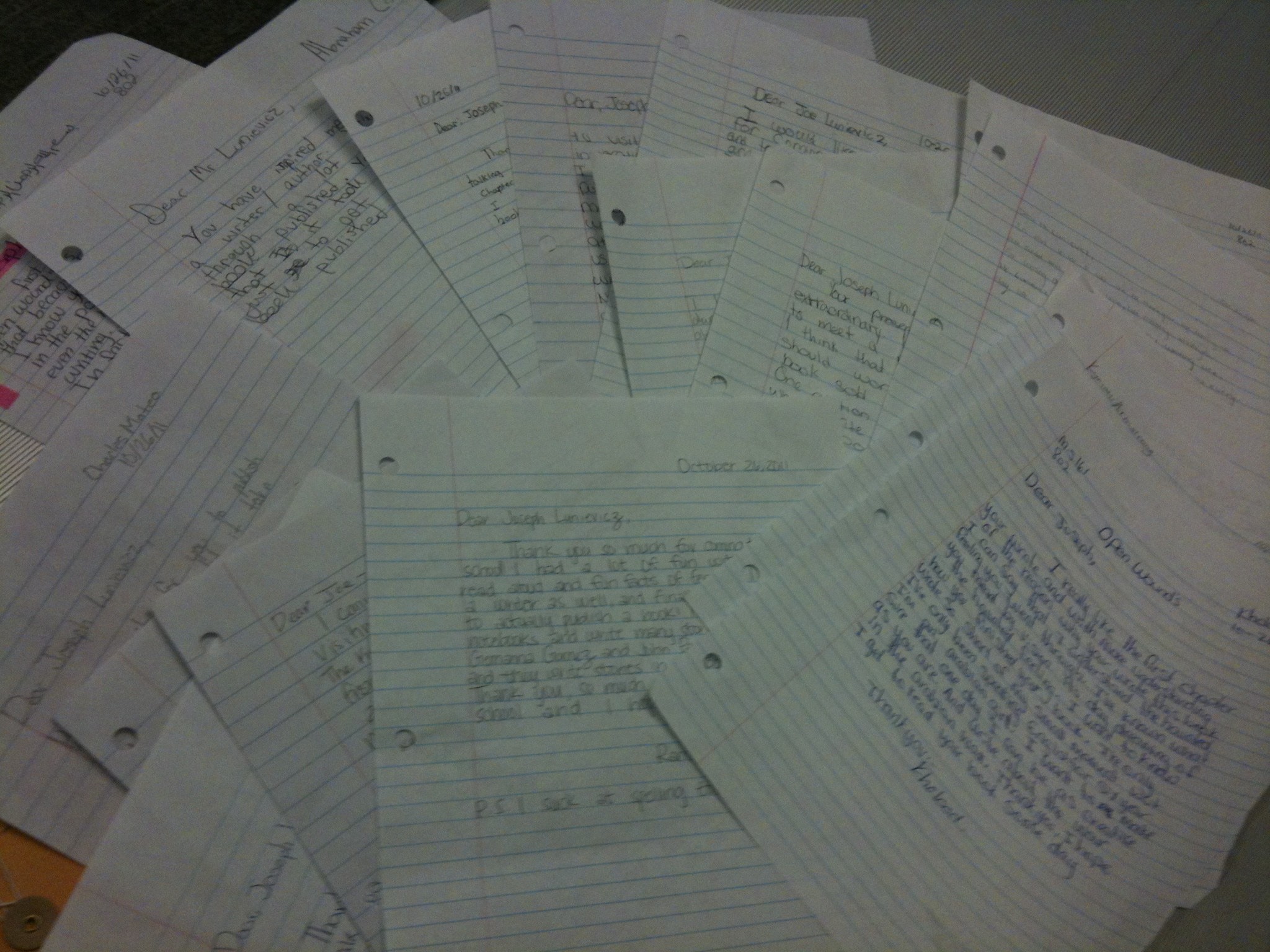
They wrote me letters.
My friend Leslie handed me a stuffed white envelope filled with them. They run from quarter page to full-page, are written in black pen and blue, with some in pencil. Some say Dear Joseph and some say Dear Joe, some Mr. Lunievicz and some Joseph Lunievicz. They all thank me for coming to their class so I’ll only share a few over the next couple of posts. I hope you find them as fascinating and wonderful as I do.
Dear Joseph,
I really like the first chapter you wrote and with more understanding of the reason why you wrote this book I can say that I understand the haunted feeling you went through. I’ve known what you meant by vision it’s day dreaming of the haunted feeling. I want to know how you finished your book. I’ve only wrote so short of my small moment but I’ve only been speaking English for six year. I’m an Arabian girl. I want to make sure that one day I can be as creative as you are. And write abou the war in the Arabian war. Thank you. I hope I get to read your book some day.
Thank you:- K.
I told them about my vision of a 72-year-old Cid Wymann (protagonist of Open Wounds) on the roof of the Chelsea hotel dueling with sharps with a man whose face I couldn’t see – the idea which consciously began the Cid Wymann story. I am always amazed at what people hear when I talk – what sticks with them as important. I love this letter.
Dear Joseph Lunievicz,
Thank you so much for coming to our school! I had a lot of fun with the read aloud and fun facts of fencing. I am a writer as well, and finally I know how to actually publish a book! I get compositions notebooks and write many stories. My friends G. and J. are me “editors” and they write stories in notebooks as well. Thank you, so much for coming to our school and I hope you come again.
Your Truly, R.
PS I suck at spelling too.
Okay. So I told them all how bad at spelling I am and at least one student heard that and took heart that she could be a writer in spite of being spelling-challenged. She’s even got an editorial pack already in place. I can’t wait to read one of her stories.
Dear Joseph,
I thank you for coming to 161 and telling us a little about your life and your book “Open Wounds”. I’m going to read that when I’m done reading my “Vampire Prince” so I thank you for coming and may god Bless you.
Sincerely, I.
Of Egos and the Red Pen of Perfection
This is the final question from a CW Post student from my reading there last month.
How do you deal with a returned and edited manuscript? It’s perfect when I hand it in.
The woman who asked this question was terrific. She knew exactly what she was asking and knew the answer but wanted to know how to deal with the red pen of perfection. Most of us think our work is perfect or close to perfect when we hand it in. Otherwise, why would we hand it in? Then an editor gets ahold of it and either slants it with language they like, find ways to make it better, punctuates it in another style, or challenges us with new questions that we have to answer in order to make the piece complete.
I knew exactly what she meant. Man did I know what she meant. Even though by this time in my writing career I’m accustomed to revision after revision after revision I still hate to see an editor’s red marks on my manuscript. It hurts. There’s no way around it. Why do they want to change my words or punctuation or thought process as filtered through the words on my page? Usually it’s because… it could be better.
I think every writer gets to the point when they’re working on a book that they just don’t want to see it again – ever. I love my books, but I also want them to be finished. I always get to the point that I don’t want to work on them anymore, even if a little part of me knows there’s more work to do. For me it’s usually a good time to let the manuscript sit like for a month or three or six. Even a week’s break after an intense period of time with a manuscript can give a whole new perspective on the piece – especially if it’s not working – and I realize it’s not working – even if I don’t want to admit it out loud.
But feedback is always difficult to take in if it’s negative and if it’s true. Either one. Now saying this – know that sometimes editors are wrong. The same goes for fellow writers in a critique group and your life partner (but my wife is always right about my work – she just is). You just have to follow your gut as to what needs to be added to your manuscript, what needs to be cut, and what needs to stay the same. Over time working with someone on different projects you learn to figure out what to ignore and what to listen to. And as a writer I think each of us learns to shape our work and give it structure that is true to what we’re trying to say. Your sense of structure – of beginning-middle-end – tells you you’re on or off target with what you’ve written.
So how do I deal with a red-inked manuscript? I take a deep breath, read through the edits, accept what’s better, and cross out what’s not. It sounds simple but it’s really a lot harder than it sounds, because it will only work if my ego is in check and I can honestly tell what’s better and what’s not. And the ego, my ego, is a tricky writing partner. But the subject of ego is for another post and a brand new, rollerball, red ink pen of perfection.
Can I Revise That Question as an Answer?
Back to the fifth question from the CW Post LIU reading last month. I got a similar question last week from an 8th grade student at MS161 but I’ll tell you that one in another post because it’s more business oriented and I answered better.
I want to get published. How do I go about it?
She was a young woman with a big smile and she asked the question with an earnestness that broke my heart. “I’ve always known I want to be published,” she said. “Always.” She stood in front of me, nervous, smiling, smiling, smiling.
“That’s great,” I said, smiling back. We both stared at each other for a few moments. It felt a lot longer to me so, uncomfortable I forged ahead. I’d just had a conversation with a young man before her who wasn’t sure what he wanted to ask me and I’d had to investigate by getting some clarity from him about his needs. “Do you want others to look at your work? Do you want to be published?” I asked these questions because I know not everyone who is a writer wants to be published and I want to be respectful of that. Anybody who writes in any context is flexing an important creative muscle and should be encouraged to continue. Some people write just for themselves. Some for their friends and family. I’d asked him because I wanted to find out what his writing needs were. This woman with the big smile knew what she wanted, very similarly to myself when I was her age. I wanted others to read my work. I wanted to be published.
But I needed more information to be able to answer and she seemed stuck. So I asked, “Do you have finished work – a novel, or short story, or poetry?”
“No.”
We stared at each other a little longer. I took a breath and nodded. “Then… you should finish your book, or short story, or poem and… send it out. That’s kind of how it works.”
She nodded and her smile (I didn’t think this was possible) got even bigger.
Then I realized what an idiot I was being.
“Okay,” I said. “I mean try not to stress over how to get published until you have something ready to publish. That’s what I really mean. You know what I mean?’ Yes, I know I was getting more eloquent as I went on. Right about now I wanted someone to get a hook out and take me off stage with a yank. Or a brick and hit me over the head with it. But there was no hook or brick and I went on anyway. “And when you’re ready you can go to The Writer’s Market and search out markets to send to, unless you already have them in mind for your work depending on what you’ve written. But, as my grandfather used to say to me, ‘How you going to get something published if you don’t send it out?’ So if you are the kind of writer who wants to see their name in print then sooner or later you’re going to have to do some marketing and The Writer’s Market is as good a place as any to start.”
“Thank you,” she said and she walked away.
Fortunately there was one more person behind her on line so I had one more chance to redeem myself. I’ll tell you her question tomorrow.


 Lunievicz