Review of Open Wounds in American Fencing Magazine
This is so cool. I never dreamed I’d get reviewed in American Fencing Magazine. Kathryn Schifferle wrote the review and it’s on page 44, under Product Review. Here’s my favorite part:
… This is a complex, well-written story. Although targeted to young adults, the descriptions of pre-World War II era New York are compelling. I could not only visualize the period, but the pain and excitement that Cid Experienced as he learned the way of the sword. In addiction the characters are diverse, multidimensional, and live in my mind still today…
Check it out! Here’s the full review.
School Library Journal Review of Open Wounds
I thought my time had passed for a review of Open Wounds in the School Library Journal Review but it seems it hasn’t. My wife caught their review on the Barnes and Noble .com site and then looked and found it in the Journal’s October 1 reviews. I’m really pleased with it. Here it is in its entirety.
School Library Journal
Gr 6 10—Seven-year-old Cedric Wymann is raised by an alcoholic, violent father and a stoic, bitter grandmother. Going to the movies with her, he becomes entranced by the sword-fighting scenes in Captain Blood and other films of the day. A chance meeting with a famous swordsman cements his fascination with the sport. Eventually Cid and two friends fight off the neighborhood bullies. After the disappearance of his father and the suicide of his grandmother, Cid spends five years in a brutal orphanage before being claimed by a British cousin who suffered the loss of an arm, a leg, and an eye in the trenches of World War I. “Lefty” becomes a caring father figure to Cid and, along with a drunken, retired Russian fencing master, guides him through the next few years as he learns to fence and studies the great works of Shakespeare. At 16, he is hired to teach local actors how to perform swordplay on the stage. Fate brings his childhood friends back into his life, and they again face the bullies they fought off years earlier, but their tormentors are now under the protection of a wealthy businessman. Of course the final face-off is at a fencing competition. Lunievicz does a good job of portraying the New York City in the 1930s and ’40s that teems with violence and hard living. However, there is a lot going on in this novel. At times it seems too crowded with characters who symbolize many different aspects of the times, but they are generally well drawn and believable. In the end, this is a novel about fencing, and the descriptions of the instruments, the action, and the finely choreographed movements of this elegant sport are riveting.—Karen Elliott, Grafton High School, WI
Thank you Ms. Elliott for reviewing my book and for the good word on it. I’ll take “riveting” as a final word any day.
The Scrum of Speed Dating
At the New York City Department of Education Library Services Conference in Brooklyn (that’s a mouthful) I was invited to do speed dating with librarians. I’ve done this before. At BEA in NYC . At ALA in New Orleans. As a matter of fact one woman I speed dated at ALA liked what I said enough to invite me to this NYC event. I feel like I can get a librarian to date me (or read my book which is probably more important). Well, you know what I mean. Connections, connections, connections. It is about relationships.
So these are the rules. There are tables full of librarians and in this instance all the authors were grouped together at one side of the room. There were some dozen tables and about 14 or 15 authors. I have to say I had to fight the competitive response. Because as soon as the microphone sounded authors sprang into action to find the biggest table first.
Some observations.
I shared my first table with a more established writer. We were nice to each other. Cordial. Smiled. We shared our time. But I could see it in her eyes. Neither one of us was going to share a table again.
When the buzzer sounded to shift tables you had to be fast or you wouldn’t get another table and would have to wait or share your time. I have to say. I’m slow and I need to get faster. Either that or talk less. At the least I have to be more aware of the buzzer. Because if you’re slow you miss the chance to get a seat at another table. The woman in charge took pity on me and found me an empty table three times in a row. Thank you, un-named librarian who helped this author to find his groove. Five librarians bought my book that afternoon – always a good thing. By the last table I, having to skip one round because I wasn’t quick enough to grab a seat, waited behind an author at a large table and as soon as the buzzer rang, took her seat. Another author raced over to try to sit in what would be my seat. I looked at him and shook my head slowly. Not this time. He moved away with a strained smile.
Some events just bring out the best in me.
Nadi Blood and Captain Aldo
Why did you write a historical novel and why did you want to write about fencing? This is a question from Ms. Maddy Black’s 8th grade class last week.
The truth is I had no desire to write a historical novel. I had no idea I had one in me. As I realized my story was going to take place in the past I even fought against it. I knew I would not be able to rely on my contemporary point of view for the novel and since I’d never worked without that before I grew overwhelmed by the concept of a historical novel very quickly. How could I possibly speak with confidence about what it was like to live in 1936 or 1942? I wasn’t even alive back then. And the more research I did the more overwhelmed I became. It seemed in order to be an expert on the era, or to feel competence in my knowledge of the era I would have to read an incredible number of heavy, thick, dry-looking books and microfiche newspapers.
But at some point my curiosity and interest in the period overcame my anxiety and I began to write. I even became so involved in the research that I overdid it and had to cut about half of what I looked up, out. I even found I enjoyed the details of life from that time period. I found it fascinating.
Also, my protagonist, Cid Wymann, was 7 in 1936 so I either wrote about him in 1936 or wrote about a different character. I’ve written before about the vision I had of a 72-year-old Cid dueling with épées on the roof of the Chelsea Hotel so I won’t go into it here – but those were my constraints. I either wrote about him when he lived or I wrote about someone else. but no one else haunted me the way Cid did. That image wouldn’t go away.
Andrew Smith (author of Stick, The Marbury Lens, Ghost Medicine, and In the Path of Falling Objects) says his stories come through him, as if he was a medium for a story that had to be told. I see writing very much the same way. The characters gnaw at me. They worry me like a dog with a bone until I start to tell their story. Writing for me is then very much a journey to figure out who the protagonist is and what his story is that needs to be told.
And why fencing? I have been in love with swordplay since I was a kid, fenced since college, and taught stage combat to actors. I find I write about things that I do, that I feel a passion for. And so the man on the roof of the Chelsea hotel was fencing and his tale began when he was 7 – when Aldo Nadi, the greatest fencer of the 20th century, perhaps of all time, came to New York City and gave a fencing exhibition at The Plaza and on the same weekend that Errol Flynn’s Captain Blood premiered. I guess you could say I had not choice. Open Wounds would be a historical novel and there would be swordplay in it.
Ms. Maddy’s 8th Grade Class
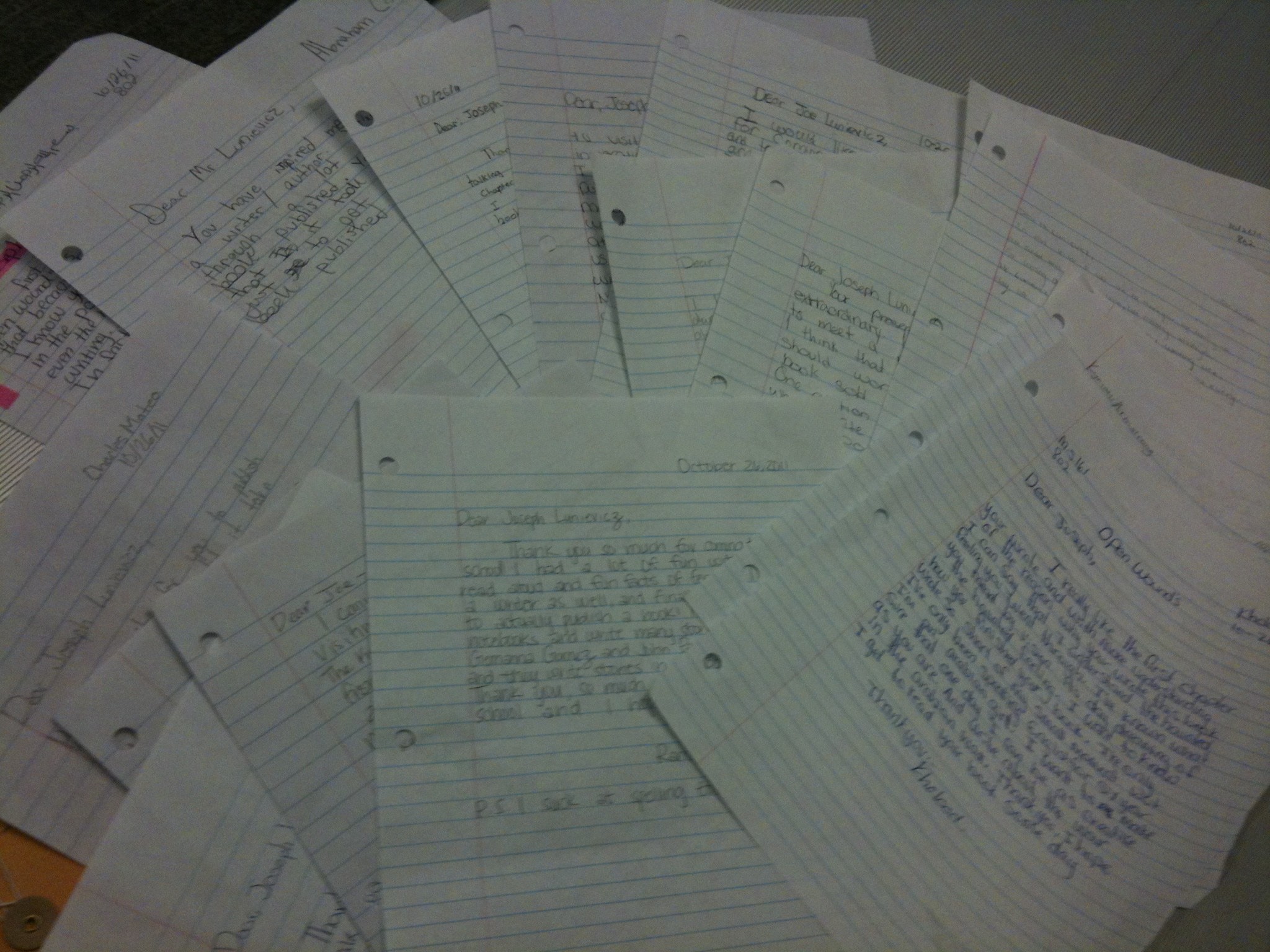
PS/MS 161 Thank You's!
They wrote me letters.
My friend Leslie handed me a stuffed white envelope filled with them. They run from quarter page to full-page, are written in black pen and blue, with some in pencil. Some say Dear Joseph and some say Dear Joe, some Mr. Lunievicz and some Joseph Lunievicz. They all thank me for coming to their class so I’ll only share a few over the next couple of posts. I hope you find them as fascinating and wonderful as I do.
Dear Joseph,
I really like the first chapter you wrote and with more understanding of the reason why you wrote this book I can say that I understand the haunted feeling you went through. I’ve known what you meant by vision it’s day dreaming of the haunted feeling. I want to know how you finished your book. I’ve only wrote so short of my small moment but I’ve only been speaking English for six year. I’m an Arabian girl. I want to make sure that one day I can be as creative as you are. And write abou the war in the Arabian war. Thank you. I hope I get to read your book some day.
Thank you:- K.
I told them about my vision of a 72-year-old Cid Wymann (protagonist of Open Wounds) on the roof of the Chelsea hotel dueling with sharps with a man whose face I couldn’t see – the idea which consciously began the Cid Wymann story. I am always amazed at what people hear when I talk – what sticks with them as important. I love this letter.
Dear Joseph Lunievicz,
Thank you so much for coming to our school! I had a lot of fun with the read aloud and fun facts of fencing. I am a writer as well, and finally I know how to actually publish a book! I get compositions notebooks and write many stories. My friends G. and J. are me “editors” and they write stories in notebooks as well. Thank you, so much for coming to our school and I hope you come again.
Your Truly, R.
PS I suck at spelling too.
Okay. So I told them all how bad at spelling I am and at least one student heard that and took heart that she could be a writer in spite of being spelling-challenged. She’s even got an editorial pack already in place. I can’t wait to read one of her stories.
Dear Joseph,
I thank you for coming to 161 and telling us a little about your life and your book “Open Wounds”. I’m going to read that when I’m done reading my “Vampire Prince” so I thank you for coming and may god Bless you.
Sincerely, I.


 Lunievicz