T is for Tartarus
 Tartarus. The prison of the cyclops and the 100 headed giants and then the Titans. A place of great darkness – a deep, gloomy place, a pit, an abyss used as a dungeon of torment and suffering that resides beneath the underworld.
What is the writer’s Tartarus? What puts chains and shackles on our arms, our legs, our thoughts?
Osho, a spiritual leader from the 60’s-70’s says about creativity, that all children begin life creative and able to be artists, but that society and the way we are taught in school drives this out of us. We are told to color within the lines, not outside; play with trucks or dolls; wear blue or pink; be embarrassed to dance or play sports; that we can read, or can not.
Kindergarten starts the process, standardized tests finish it.
Osho was on to something. I have seen all these cultural beliefs (based on social values, not nature) placed upon my son by teachers, other children, by parents, sometimes even myself. Everyone is influenced by them in some way even if we do not act upon them to the same degree. Conform or be sanctioned (looked at differently, nobody will be friends with you, made fun of, verbal abuse, physical violence).
We start off as creative beings and lose sight of that wonderful freedom, so says Osho. Many think Osho was crazy too. I think he was a mystic, a crazy mystic who journeyed inward.
For me, writer’s block, the inability to write, is a personal Tartarus – a cell in the underworld with a grill that lets in only a sliver of light. It’s like Steve McQueen’s cell in Papillon (one of my favorite books and movies).
Loss of faith in myself and my work and a publishing system that grinds up writer’s and eats them for breakfast helped me to place myself there. I say place myself there because I own that the space is mine. I created it and I have existed in it. It is a part of my process. I know my own process of writing has ebbed and flowed over the 34 years that I have been writing and sometimes publishing. A few years ago I lost faith in myself – in my writing. In Papillon, Steve McQueen paces back and forth, eats cockroaches and water-bugs, talks to himself while his teeth fall out and he waits for his opportunity to escape.
I’m not big on water-bugs or cockroaches, even if they are high in protein. And I’d like to keep my teeth.
 What saved me in my cell was that although I couldn’t write much in the way of new fiction and could not start a new book, I could still edit and I could still write other things. I kept my muscles working, even if only a little. I paced in my own way and looked up at the sliver of light that came from the grill.
I wrote blog entries about my son and being a father.
I wrote poetry.
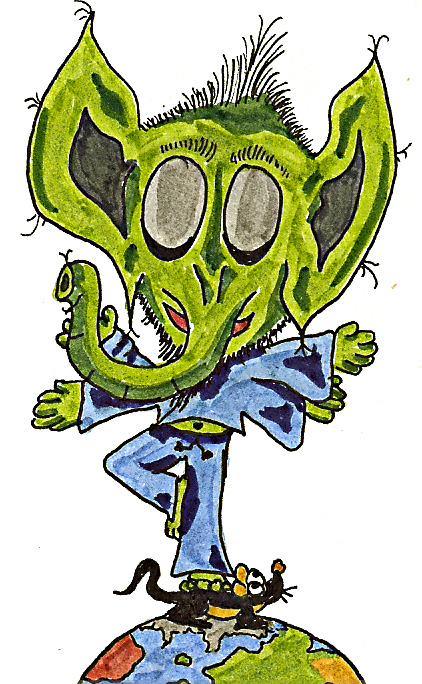
I drew a lot – Faber Castle markers have always been my favorite. What I couldn’t put in words I put in pictures.
Until I found the door to my cell was no longer locked. I pushed it open, looked outside and started writing again. My process had changed. The words have not flowed as easily. But I have a deeper faith in myself. To me that’s the only way to get out. It’s better than waiting for Zeus to get you out. He’s got other things to do. He’s a God after all. And Greek.
S is for Sisyphus
 Sisyphus was one ruthless, murderous (at least three people and children as told in stories about him), sly, crafty, iron-willed, Machiavellian, power-hungry, bastard of a Greek king. He was an absolute evil genius that regularly outsmarted Gods (Zeus and Persephone in particular) and mortals alike. Of course he took a fall eventually and Persephone (Goddess of the underworld) took him to task (after he played her the fool twice) and made him pay for all his trickery. His ultimate fate is to roll an immense boulder up a hill and upon getting it to the top watch it roll all the way back down, only to roll it back up, again and again. He’s probably (probably?) still at it right now. Now there’s a story to be written (Rick Riordan are you listening?). A Sisyphean task is one that is endless and can never be completed, no matter how hard you try.
Sometimes writing a novel seems like a Sisyphean task. It seems endless with restarts and stops. It is soul crushing at times (dealing with writer’s block), humbling (critiques and rejections, oh my), and the words the end seem like they are unreachable, no matter how close you get or how hard you try.
Which is why when you finish a first draft and write the end, it is so damned satisfying. No matter the rock rolls back down the hill for draft two through nine-teen. Because it doesn’t roll back down all the way and although the peak gets higher, it is a new peak to push the rock up to. And eventually, if we do our work well enough, we get to a top (after copy editing and final final editing and final final final editing with a publisher) and the damned thing doesn’t roll down at all.
Of course then it’s time to create a new rock to roll up the hill.
But for a few moments, on top of the hill, rock firmly in place and unable to roll back down, the view is pretty damn good and the air is very very sweet.
R is for Rhea
 Rhea is the mother of the Olympian Gods (7 including Zeus) and wife of her own brother, Chronos. I mean, how many titans could there have been to choose from? Chronos eats all his kids but Rhea feeds him a stone (large one) swaddled in blankets instead of her last son, Zeus. Zeus escapes and as we all know from the Percy Jackson Tales (at least that’s been my refresher course) he rescues his siblings and puts the titans in their place. Saved by mom and a big swaddled stone.
Its made me think of mothers and their place in the books I’ve read recently. I just finished Michael Grants Gone – a wonderfully creepy story about kid survival practically without the presence of any mothers (or fathers) at all – even though one mother’s actions are key to the plot and kids act as “mothers” of different types. Mr. Grant can spin a tale and take it down some dark paths. But his tale represents the absent mother motif.
The present and struggling mother comes from A.S.King’s Everybody Sees the Ants – in which the mother swims to cope. She is not the protagonist but the story could not be told without her struggling presence. I love this book.
There’s also the mother with the heart of gold, the evil mother, the step-mother (good, bad or indifferent), the replacement mother, the oh my God what a mother (okay I just made that up), the mother who dies in the first scene or before (thank you Disney – that’s their speciality). How many others can you think of?
How do you write these characters as authentic human beings? Read King’s book to see. The mother is called the squid but she is not defined by her squidiness. As with any character in a book, so too in real life.
Q is for Questions
 It’s late and I have had a cold for three days that has masqueraded as an allergy. Don’t you hate when that happens? I’m sitting with a tissue stuck in my nose. If you know me you know that means there is a prodigious tissue in front of my face , just below eye level. They don’t call me The Nose for nothing.
Questions.
Socrates was a Greek thinker from ancient times, a real smart dude who had a method (the Socratic method) of thinking that has been taken on by teachers worldwide – at least those who believe in having their students listen, think, respond.
Writers are great thinkers. If you write you are exercising your mind – asking questions of the universe great and small. Some through fictional enquiries and some through essays, some through the retelling of what has already happened and placing your perceptual imprint on it.
We ask questions of our selves and of the worlds we create, reflections or mirror images of what we see and perceive around us. I think one of the reasons writing is so hard is because of the amount of thinking required. So much has to live within our minds then get translated into words and placed on paper. It’s easier to let the mind run the way it wants to, harder to rein it in, even harder to make it think.
When my son writes I watch as small light bulbs go on across his forehead, some colored green and purple, others colored bright pink and orange- some the shape of sausages. He’s asking himself questions and answering them for himself, one after the other, maybe even taking a bite or two.
What questions lead you forward when you write?
For a look at the answers to my interview questions for Amalie Howard, author of Bloodspell, take a look at this link and see what colored lights go on around her head.
P is for Piss
 There is a lot of versatility inherent in the word piss (Greek ὀμείχειν (omeikhein), “to urinate”). It also has a great sound. It sounds like it’s act when you focus only on the act of urination (onomatopoeia). But there are other uses far and wide for pissing. For example:
- I piss.
- I have pissed.
- I am pissing.
- In the process of pissing, I am a pisser.
- I’ve been pissed on.
- You’re a pisser (meaning funny or encourage-able).
- Don’t piss around (waste time).
- I’m pissed off (meaning angry).
- Go piss off (get out of here).
- I’m getting pissed (angry).
- I’m getting pissed (drunk).
- Let’s have a piss up (drinking session).
- Don’t piss me off (as a warning).
- It’s a pissing contest (either a real contest to see who can piss the furthest or longest, or a metaphor for a game of one-upmanship).
- I’m standing in a pool of piss (either really standing in one or a metaphor for being in deep trouble).
- I don’t have a pot to piss in (meaning poor).
- You’re a piss pot (or a receptacle for piss)
- I’ve engaged in piss play (a golden shower, a sexual act of pissing on another).
- Don’t piss down my back (ruin what I’ve done).
- You are a pissant (worthless person – comes from the 14th century word for a type of ant – pismire).
- Those are piss-ants (large wood ants that piss alot).
- This place smells like piss (olfactory usage).
- Don’t be so pissy (irritable).
- You’re a piss stain (insult).
- He pissed his pants (fear).
- Wicked pissah (really good thing).
- Piss rhymes with bliss – I’m just saying.
Here’s from the King James version of the bible:
2 Ki 18:27 But Rabshakeh said unto them, Hath my master sent me to thy master, and to thee, to speak these words? hath he not sent me to the men which sit on the wall, that they may eat their own dung, and drink their own piss with you?
And Shakespeare:
1611 Monster, I do smell all horse-piss; at which my nose is in great indignation. — Shakespeare, The Tempest, Act 4, Scene 1.
or
1601 O Jove, a beastly fault! And then another fault in the semblance of a fowl; think on ’t, Jove; a foul fault! When gods have hot backs, what shall poor men do? For me, I am here a Windsor stag; and the fattest, I think, i’ the forest. Send me a cool rut-time, Jove, or who can blame me to piss my tallow? Who comes here? my doe? — Shakespeare, The Merry Wives of Windsor, Act 5, Scene 5.
A.S.King, in her book Everybody Sees the Ants (an awesome, brutal, wonderfully written coming of age tale) uses a bully pissing on the protagonists shoes as a key plot point. James Clavell, in Shogun has a scene early on of men pissing on the backs of prisoners – a scene that has stayed with me for over thirty years. These are writers using all the tools human beings in all their majesty, their light and their dark, have given them.
Sometimes human nature and the English language come together… beautifully.


 Lunievicz