B is for Blade
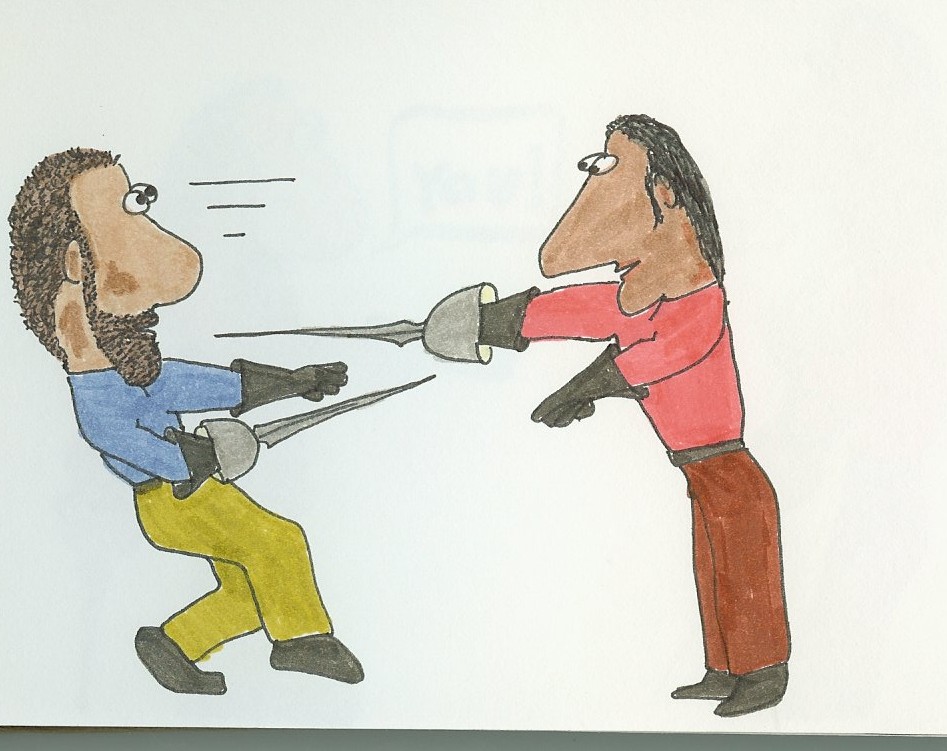
What do you do with this thing?
You stick him with the pointy part.
Different types of blades were used in different ways. Let’s look at a typical one-handed medieval sword. It’s main weapon was its edge, not it’s point. The point wasn’t really used a lot during the middle ages. Armor stopped it. Big heavy swords were used more for smashing and hacking. Still for swordplay know that there are two ends of a sword one with a pommel (heavy enough to counter balance the blade and to smash into things like people’s faces) and the other with our famous point. The cross guard is nice for stopping opposing blades from sliding down and cutting your fingers off but also wonderful for punching into the face. You’ll notice a theme here. Pommel to dross-guard is the hilt. The blade has two parts a forte (or strong) bottom third closest to your cross-guard that is used to parry or block your opponents strikes and a foible (or weak) upper third for cutting your opponents in half. The sharp edge can be on both sides (two true edges) or one in which case the blunt side is called a false edge.
 All swords in one way or another have these parts even if they look different and are different sizes. Some things to remember about sword fights whether they are with medieval swords, renaissance rapiers, small-sword from the 17th century or the American Civil War. You can fight clean or you can fight dirty. If you fight dirty because it’s an ambush on a city street or you’re a soldier in the middle of a large battle, you will use any and or all the parts of your sword to get rid of your opponent(s). If you are fighting a duel you will probably use the blade only but that depends on the upbringing of the combatants (royalty, upper class, training, personality). And different blades are used to do different things – the use of the edge versus the use of the point. To see visually how two very different blades and upbringing can influence how a fight happens see the following two films:
Rob Roy – the final duel between Rob Roy and the English antagonist is a duels between the past (a large two-handed claymore – which is a heavy hacking edged weapon) and the present (a long, thin, pointy small sword that uses the point to do damage). This is choreographed by famous English fight choreographer William Hobbs. These two characters fight the way their personalities tell them to. The fighting is not generic, it is character-based. A good lesson for all writer’s to learn.
Watch any of the fights in Game of Thrones and then watch the scenes of Arya training with Syrio. Two-handed medieval broadswords are weapons of strength while Arya’s Needle is more point than edge (swords from two very different time periods but hey, it’s a fantasy novel so you can do whatever you want!).
A is for Actors On Guard
 Actors On Guard, by Dale Anthony Girard – a great book on the use of the rapier and dagger for stage and screen.
A young man, a kid really, is doing choreography with a rapier, musketeer blade (double wide épée), cup hilt. He does the choreography well with his partner, an experienced actor and stage combat veteran named Dave. Dave is waiting for the kid to start his schtick.
“What’s the real thing like?”
So it begins.
“I bet I could hold my own in a fight with one of these.” The kid’s looking at the blade with confidence.
“Sure you could,” Dave says. He’s tired from almost three hours of fencing choreography – two classes, a beginner’s class and an advanced. This is the advanced class. He’s sweating and perspiring. He worked all night at his seventeen-year proofreading job, graveyard shift. He won’t go to sleep until that evening – if he can last. Its been 24 hours since he slept.
“Seriously, Dave,” the kid says. “Why won’t Joe fence against me?”
“Just stick with the choreography.”
“I bet I could fence against you.” The kid thrusts his blade tip at Dave’s chest.
Dave bats it away with his hand – his leather gloved hand. He’s more awake now. “You’re not a fencer,” he says with just a bit of an edge. “You’re an actor.”
“I’m pretty good,” the kid’s bouncing on the balls of his feet. “I could fence.”
“Joe,” Dave shouts and turns away from the kid. “Kid wants to see what it’s like to fence.”
An older man, probably in his seventies – the decades speaking in the lines of his face – rouses himself from reading the paper at the teacher’s desk. He slaps the newspaper shut and stands up, pushing his chair back. “David,” he shouts back. The rest of the class stops their work on the days choreography to see what’s happening. “Get the kid suited up.” He smooths back his white hair with his fingers and walks over to a locker, pulls out his gear. Dave gets the kid suited up with fencing jacket, mask, glove, competitive sabre. The old man suits up in similar whites. His fits loosely, like he used to fill it out more. Still he wears it with familiarity. He walks past the kid with his helmut under his arm. He turns smartly. Dave has pushed the rest of the class back so they’re all against the wall – out of range. All except the kid. Dave’s put him in the center with the old man.
“We’ll do three touches,” the old man says. “Dave, you’ll judge.” Dave nods and the old man salutes him, the kid, and the audience, then puts on his mask. The kid, a huge smile on his face, copies him.
“Fencers ready?” Dave asks.
The old man nods and says, “Yes, sir.” He is still. His sabre in the line of three.
Dave repeats his question to the kid. The kid is nervously swaying back and forth, the blade moving from side to side.
“Fencers ready? Dave asks him a third time.
He nods finally.
Before the kid can take a step forward the old man slashes his sabre’s edge across his chest. The kid stumbles back a step clutching his chest with his free hand. He rubs it smartly.
Dave hears him breathing shallowly. He knows that one hurt, even with a canvas jacket on.
“Fencers ready?”
The old man cuts the kids arm and the kid grabs the place where he was hit.
“You ok?” Dave asks sweetly.
The kid nods.
Third go.
The old man waits this time. He drops his guard down, inviting the kid in to an open target. The kid attacks. He cuts to the old man’s head. The old man parries easily in five and smacks the kid hard in the head, hard enough to make him stagger back a step and to make the rest of the class gasp.
The old man swipes off his helmut and throws it to Dave. “Carry on,” he says and retreats back to his desk where his paper waits for him.
Dave directs the others to go back to their choreography. He walks up to the kid. “Ready for choreography?” he asks.
The kid nods. He’s still wearing his mask. He still hasn’t moved.
For the A-Z challenge I’ll be talking sword-play, every letter of the alphabet. I love to fence and I love to do the choreography of stage fencing. Outside of playing rugby there’s just about nothing better. As a writer who’s first book has more fencing and stage combat in it than most I hope this unique expertise can help others figure out how to write about the use of the sword whether it’s a small sword, a foil, a broadsword, a bastard sword, or a rapier and dagger. Maybe it’ll help with your next fantasy novel or historical. If you have questions, ask. Otherwise onward tomorrow to B.
Sights, Sounds, and Smells

My friend and mentor Dr. Digby from CW Post LIU (my alma mater) has asked be to take her small English class to Manhattan to see the world of Cid Wymann first hand. They’re reading Open Wounds now. I’m going to talk to them about how you can make the past come alive in a historical novel.
I’m very excited about it (not the amount of work I will put into it – more than I need to probably but that’s my problem). I went to talk to The Fencer’s Club (on 28th) folks today to see what time on a Saturday October 20th, would be good to bring a dozen non-fencers to watch the goings on and maybe get a short talk about the history of the club – and… not get in the way of the fencing.
I’ll have them sit and listen to the sound of fencers going at it. I love that sound. Then there’s that smell of sweat from fencers who haven’t cleaned their uniforms in ages. Ahhh.
Then the Hotel Chelsea where Cid lives with Lefty down on 23rd. It’s under construction with a new interior renovation and new owners so we can’t go inside but at least the outside looks the same.
Then two avenues over to where I placed the fictional Gotham Fencer’s Club but where at some point prior to 1930 there was an author’s club near 28 West 24th Street.
Then down by subway – the R train – to the bloody angle (not from Gettysburg) in Chinatown on Doyers where the Rescue Society Mission used to be and where I placed an alley that leads down and deep underground to an opium den where Lefty tries to disappear from the pain of life.
Finally we’ll end up a little north at the lower east side on Grand where Siggy lived at the Amalgamated and over to Orchard where he worked selling pickles from a push-cart.
I might be a little too ambitious.
We’ll see.
I’ll let you know as I get closer.
Oh… and just ignore the fact that I’ve been away form a month and some. I’ll tell you about it later.
Flesh Fleche
Back at the Virginia Festival of Books in Charlottesville.
The Charlottesville Fencing Alliance is off Allied Road and McIntyre a short fifteen minute walk from the Omni. I visited two evenings last week, fenced 8 times (thanks Ken 2x, Dave, Drew, Emily, Sarah, Chairon, and Aron for your lessons in humility) , winning 2 of 4 the first night and 1 of 4 the second, for about 90 minutes each night, talked shop with the members between bouts, and pitched my book to anyone who would listen. I left four copies of Open Wounds to be used for prizes in tournaments, a ton of book marks, and a lot of sweat.
 The director, James Faine, was a great host and has a terrific club to boast about. They fence foil, sabre, and épée with a good number of sharp épéee-ists on hand – a number of which are lefties – always tricky to handle. That’s a nice way of saying they kicked my butt.
The picture of the fleche is Ken (red hair) with a perfect touch against Sarah.
I’m still a bit sore from all the leg work but I’d do it again in a second. I’ll have to bring my equipment when I go to New Orleans next month – see if I can get in another evening of swordplay. Oh yeah, and sell some books!
Doing the Rocky Dance
 I was away last week at the Virginia Festival of the Book. I did no blog entries. I’ve been in Charlottesville Virginia, moving between the Omni, downtown, Emmit Road B&N, Allied Road Charlottesville Fencing Alliance and Allied Yoga. Oh, and the AMTRAK station.
I took a seven hour AMTRAK ride down and wrote some while my butt rode the rail. That made me smile.
Here’s the other thing that made me smile besides the beautiful town, the nice and friendly people, and the warm weather and flowers.
Barnes & Noble in Charlottesville carried my book there. There’s no other B&N in the country that carries my book. But in Charlottesville VA, they carry it. That’s cool.


It’s in two different places, the New Teen Fiction section and the table with all the books from the book festival authors – at least that’s where it will be until the end of today when the festival closes. This was the best series of events I’ve ever done. Seriously. If you ever get the chance to do this as an author, don’t hesitate, do it.
 Panel I, Fiction: Conspiracies and Obsessions – I did with three very cool authors – Alma Katsu (The Taker), Amelia Gray (Threats), Virginia Moran (The Algebra of Snow) – and an even cooler moderator named Meredith Cole. Meredith knows how to moderate (not as easy as it would sound). She gave us a series of questions she would ask ahead of time, met us 30 minutes before the event to get to know us and help us settle in, and read all four of our books so that when she introduced us and asked us questions she knew what she was talking about. Meredith rocks. And, she’s a heck of a good mystery writer herself.
 There were over 60 people at the even at the Barnes and Noble in town. They were standing in the aisles and sitting on the floor. That was a very cool thing to see. I don’t know who they were there to see and I don’t care. We all had a good audience to talk to and the panel kicked butt. Seriously. These women were funny and interesting and I added a touch or two myself, but watching the ladies work, I wanted to be in the audience myself. I had fun and… sold ten books, at least as far as I can remember. j
 The Festival volunteers were helpful. The B&N staff were helpful. I probably had too much coffee because my hands shook. Or it could have been the influence of the Christianity section behind us. Or that might have been my nervousness showing. In any case it couldn’t have gone better.
Tomorrow I’ll tell you about the fencing. Oh yeah, and Panel II with Elizabeth Nunez.


 Lunievicz

