Can I Revise That Question as an Answer?
Back to the fifth question from the CW Post LIU reading last month. I got a similar question last week from an 8th grade student at MS161 but I’ll tell you that one in another post because it’s more business oriented and I answered better.
I want to get published. How do I go about it?
She was a young woman with a big smile and she asked the question with an earnestness that broke my heart. “I’ve always known I want to be published,” she said. “Always.” She stood in front of me, nervous, smiling, smiling, smiling.
“That’s great,” I said, smiling back. We both stared at each other for a few moments. It felt a lot longer to me so, uncomfortable I forged ahead. I’d just had a conversation with a young man before her who wasn’t sure what he wanted to ask me and I’d had to investigate by getting some clarity from him about his needs. “Do you want others to look at your work? Do you want to be published?” I asked these questions because I know not everyone who is a writer wants to be published and I want to be respectful of that. Anybody who writes in any context is flexing an important creative muscle and should be encouraged to continue. Some people write just for themselves. Some for their friends and family. I’d asked him because I wanted to find out what his writing needs were. This woman with the big smile knew what she wanted, very similarly to myself when I was her age. I wanted others to read my work. I wanted to be published.
But I needed more information to be able to answer and she seemed stuck. So I asked, “Do you have finished work – a novel, or short story, or poetry?”
“No.”
We stared at each other a little longer. I took a breath and nodded. “Then… you should finish your book, or short story, or poem and… send it out. That’s kind of how it works.”
She nodded and her smile (I didn’t think this was possible) got even bigger.
Then I realized what an idiot I was being.
“Okay,” I said. “I mean try not to stress over how to get published until you have something ready to publish. That’s what I really mean. You know what I mean?’ Yes, I know I was getting more eloquent as I went on. Right about now I wanted someone to get a hook out and take me off stage with a yank. Or a brick and hit me over the head with it. But there was no hook or brick and I went on anyway. “And when you’re ready you can go to The Writer’s Market and search out markets to send to, unless you already have them in mind for your work depending on what you’ve written. But, as my grandfather used to say to me, ‘How you going to get something published if you don’t send it out?’ So if you are the kind of writer who wants to see their name in print then sooner or later you’re going to have to do some marketing and The Writer’s Market is as good a place as any to start.”
“Thank you,” she said and she walked away.
Fortunately there was one more person behind her on line so I had one more chance to redeem myself. I’ll tell you her question tomorrow.
7 Years Lost and Hard Labor Found
I went to Harlem today to visit a middle school’s eighth grade – PS/MS 161M, Don Pedro Albizu Campos School on 134th and Broadway. It’s right next to City College where I spent a year taking graduate classes in their creative writing masters program. I ran out of money after one year and never went back, but it was a good experience never-the-less. My friend Leslie set it up. She’s an Assistant Principal at the school and, after reading my book, accepted my offer to come in and talk about it with her eighth grade students.
The Library/Media Center was packed with 40 eighth graders, one teacher, and the Librarian/Media Center specialist. They had a smart board ready for me. I laid out my fencing weapons – a foil, a sabre, an épée, and a stage rapier, then talked for twenty minutes, read for twenty minutes and answered questions for ten.
Q&A can be tricky with eighth graders. There can be a lot of silence. These kids were great but I was worried at first as only one girl raised her hand. A boy and another girl seemed to raise their hands but then put them down. Perhaps it was peer pressure or maybe they were just stretching.
I called on the girl with her hand still assertively raised. Thank God she had a question. She opened a notebook she had with her, gazed down what seemed like a list of questions she had prepared, and asked the first of half a dozen that she would try to get to. I don’t remember what her first question was because right after I answered it five hands sprang into the air, then another few right after that. And the questions were good and they kept coming. Here’s a sampling of them:
- How does publishing work? How do you get a book published?
- Did your parents support you in trying to be a writer?
- When did you know that you wanted to be a writer and what made you come to that decision?
- What do you think it takes to be a writer?
- Are you working on anything new?
- Who was helpful to you along the way – like teachers or other people?
- Have you met famous authors since your book was published?
But this was the best. It wasn’t one of their questions. It was their answer to a question that I asked them. “Which would you rather do, take seven years to write a novel or one month? How many say seven years?”
Almost half the room raised their hands. I was in a bit of shock. I didn’t think any would.
“How many say one month?”
The other half raised their hands.
“Of those who said seven years, why did you say that?”
The girl who asked the first question raised her hand. “Because if it takes seven years then when I hand it in, it will be perfect.” Brilliant. Absolutely brilliant.
“And why one month?”
A boy raised his hand. “If it takes only one month then I’m writing really well, really fast.” Brilliant again.
I left three books with them – one for each class teacher and one for the library. How could I not? And whoever said middle school years were the lost years?
How Lawrence Block Saved My Ass
A writer friend of mine and I were talking recently about her present writing project and, being interested in her project and wanting to help her out, I offered to read a sample chapter for her. She said yes,with a big smile and we were off and running. Before I left though I turned to her and asked, “Okay. What do you want me to do?”
“What do you mean,” she said, still smiling but straining a little.
“You can ask me for what you need when I read it and I want to make sure I help you out so… what do you need me to do, in addition to reading it?”
She looked at me for a long moment, then , smile disappearing, said, “I don’t know. I mean…what do you mean? I never thought about that.”
“I can critique , look for strengths, look for weakness, line edit, read and give overall impressions, look at narrative structure or character, read and tell you I love it, read and tell you to send it out immediately – does that help? I want to help but I want to help you the way you need help.”
The smile appeared again. “I never thought about it that way. Let me think what I need and I”ll let you know when I send the manuscript to you.”
“Excellent. I’m excited to read it.”
This was not the first time I”ve come up against this. In a writer’s group I was in once we allowed each other to ask for what we wanted in a critique – since critique means different things to different people. One new writer auditioning for the group said to me, “But what good is it if you don’t get feedback that tells you what needs to be improved?”
I said, “Sometimes you need just to hear yourself read a piece out loud or get an audience reaction (facial, verbal, energy, laughter, snickers). It all comes back to what you need. Not everybody needs a knife taken to their work.” He didn’t like this and decided not to be a part of the group – probably for the best.
A couple of years later I was working on a memoir of my time working at Gay Men’s Health Crisis doing HIV/AIDS work and it was very painful stuff to put down on paper. At a writer’s retreat I decided to read some of it out loud to the other writers. I asked for what I wanted before I read. I was used to doing this by then so I did. I just wanted to hear what it sounded like. It was too personal to be critiqued yet and I said so. When I was finished reading, one writer raised her hand to comment and when I called on her she started to take it apart. I stopped her in the middle of her fourth or fifth sentence and said, “I don’t want a critique. I’ll take a question about the material – ” and she interrupted me. “But you need to hear -” and that’s when Lawrence Block saved me. He said (yes, he was one of the writer’s at the retreat – the Lawrence Block of Matthew Scudder, best seller, fame), “Didn’t you hear what Joe said? He said he just wanted to read it out loud.”
There was scattered applause, like softly popping incendiaries. Then I took my seat back in the group and another writer took the reader’s chair.
Thank you, Larry.
Ask for what you need. You’re allowed.
KLAATU and Keynote at the Historical Society
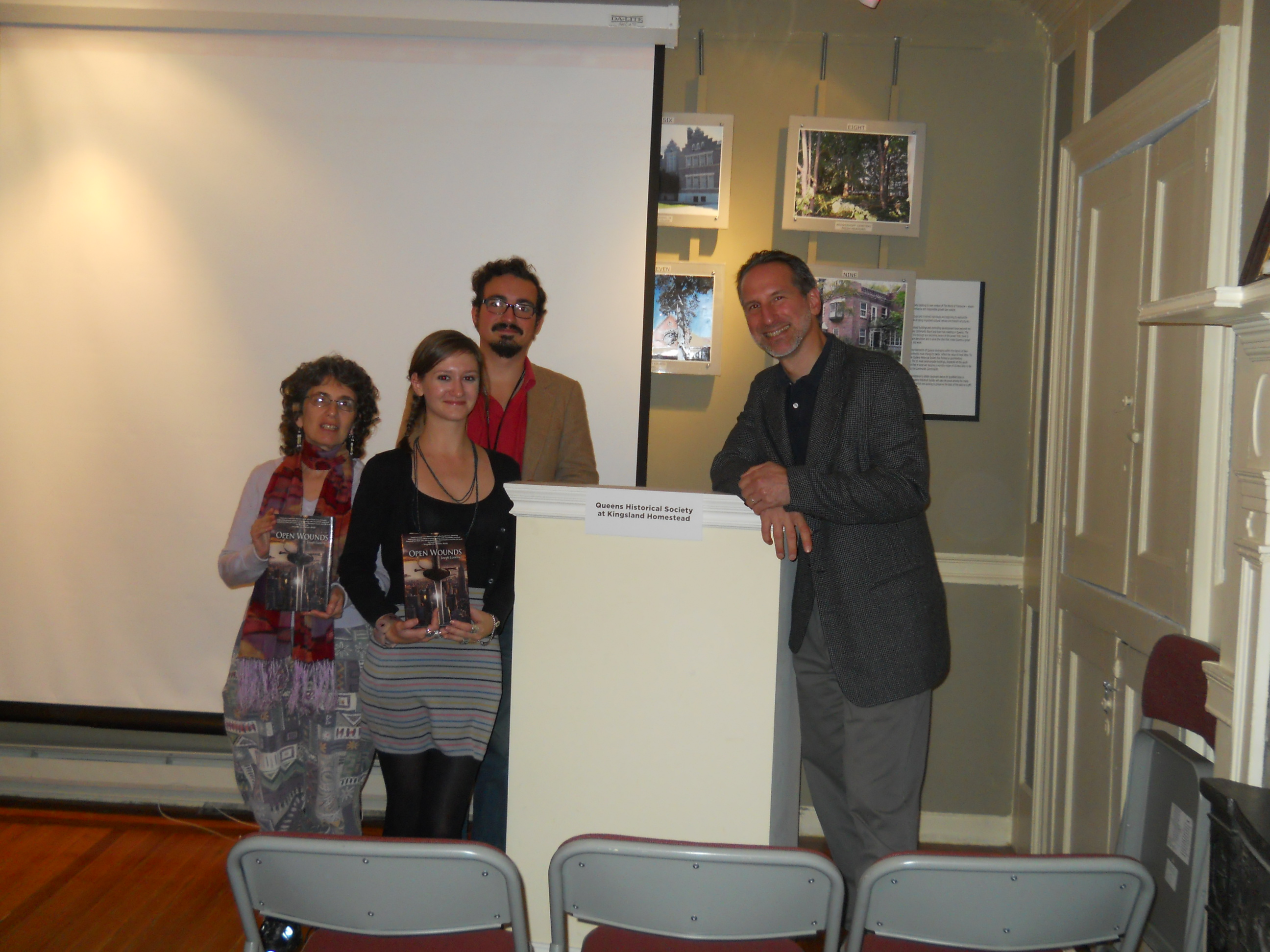 Reading at The Queens Historical Society on Thursday evening. We were supposed to start at 6:30 and it was 7pm and no one was there. Well… there were three people there but two worked there and one was a boyfriend of one of the women who worked there. The young man and I were talking about fencing so intently neither one of us had noticed that it was after 7pm and no one had shown up for the reading. Don’t get me started talking about fencing.
Of Grant Monsters and Historical Societies
I’m presenting/lecturing/reading at the Queens Historical Society tomorrow evening. This is cool. I wrote a historical novel that takes place in Queens and Manhattan and the Queens Historical Society asks me to come speak at their author lecture/reading series. I’m pretty excited about it. I better get drressed up.
But first I have to finish my grant application for my day job. It’s due this afternoon at 12pm which means it must be finished by 10 so it can go out at 11 to be hand delivered. I have one more line to cut. It’s a different kind of writing, grant writing. It’s not very pleasant but it’s a skill that helps my fiction writing so I do it. Oh yeah, and it helps me keep my day job. And I can’t give it up yet. So I cut one line. Sounds easy until you see you’ve cut everywhere else after reading it over and over the day before into the night. But I digress a bit.
I’ve never been to the Queens Historical Society. I don’t know who will be there or what kinds of questions I’ll get but it will be different. I’m going to speak about the creation of Cid, the protagonist of Open Wounds, and how he came into being. He’s from Sunnyside, only two towns – about 30 minutes walk – from where I live in Jackson Heights. The 7 train takes you there in five minutes. The 7 also takes Cid in to Manhattan to see Captain Blood on his first day of freedom.
The reading runs from 6:30-8pm. Here’s the address of the Society:
|
Weeping Beech Park
143-135 37th Avenue
Flushing, NY 11354 |


 Lunievicz