C is for Capo Ferro

Lunge
Capo Ferro has not nothing to do with Italian food or stringed instruments.
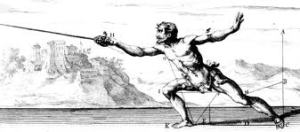
It, or rather he, has everything to do with what we know about actual rapier, rapier and dagger, and sword and buckler (shield) fighting from the renaissance period. Since we don’t have film from back then and no photographs, we have to go by line drawings and any books that were written that described it like the one above from Capo Ferro’s book Italian Rapier Combat originally published in 1610. I bought my copy in Portland from Powell’s Books (awesome indi and just a huge huge store). This book is a series of plates with short explanations of the positions and moves of Italian rapier fencing. The Italians were known in the 16th into the early 17th century to be the best with the sword. The French surpass them later but not for a long long time. Ferro was a fencing master in the city of Siena. My favorite are the many images that show (see below) what happens when you are successful in attack. Notice the three different angles the blade can take and the successful parry with the dagger.

Of course this is 1610 Italy so most people in the plates are fencing naked or mostly naked (very strategically placed scraps of cloth or leaf)- not sure I’d recommend that – must have been very hot in Siena.
Here are some words from the first section: Some Remembrances or True Advices of Fencing
First, if you are found at blows with your adversary; you must always have the eye on the sword hand more than in other places, all of the others are false, because looking at the hand you will see the stillness and all the movements that it does, and from this (according to your judgement) you will be able to determine what you will have to do.
Methods that one must hold against a brutal man:
If you have to encounter a brutal man who, without misura and tempo, hurls many blows at you with great impetus, you will be able to do two things. First adopt the interplay of mezzo tempo, as I will teach you in its place, you will strike him in his hurling of the point, either by cut in the hand or in the sword arm. Otherwise, you can leave him to proceed at emptiness with somewhat voiding the vita backwards, and then you instantly drive a point into the face or chest.
Needless to say, I chose Capo Ferro as a model teacher for my protagonist in my novel Open Wounds.
How could I not?
B is for Blade
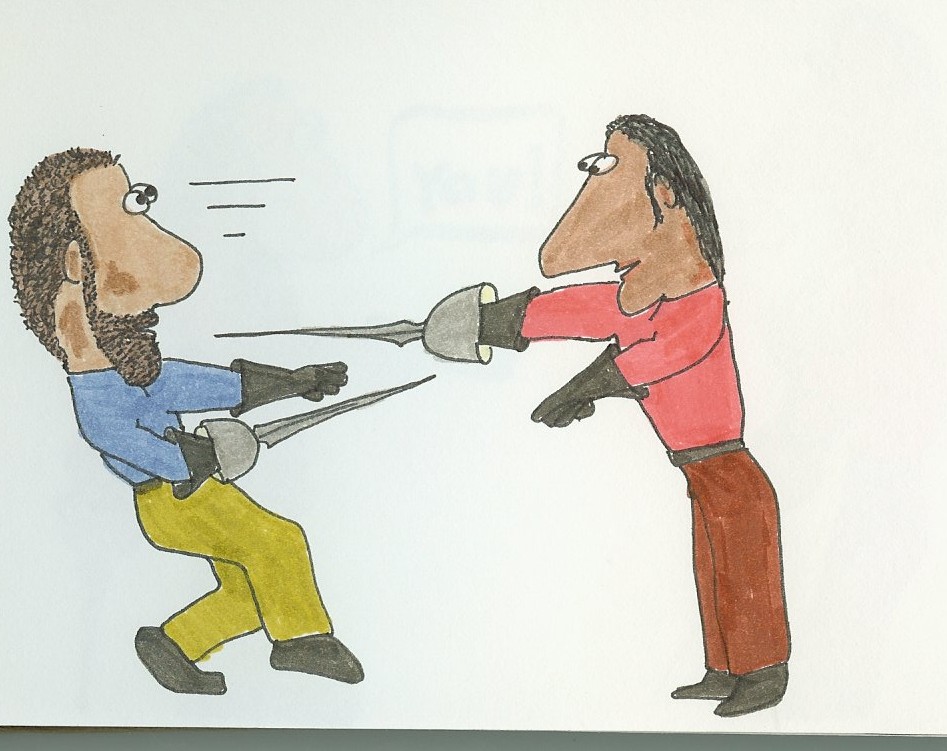
What do you do with this thing?
You stick him with the pointy part.
Different types of blades were used in different ways. Let’s look at a typical one-handed medieval sword. It’s main weapon was its edge, not it’s point. The point wasn’t really used a lot during the middle ages. Armor stopped it. Big heavy swords were used more for smashing and hacking. Still for swordplay know that there are two ends of a sword one with a pommel (heavy enough to counter balance the blade and to smash into things like people’s faces) and the other with our famous point. The cross guard is nice for stopping opposing blades from sliding down and cutting your fingers off but also wonderful for punching into the face. You’ll notice a theme here. Pommel to dross-guard is the hilt. The blade has two parts a forte (or strong) bottom third closest to your cross-guard that is used to parry or block your opponents strikes and a foible (or weak) upper third for cutting your opponents in half. The sharp edge can be on both sides (two true edges) or one in which case the blunt side is called a false edge.
 All swords in one way or another have these parts even if they look different and are different sizes. Some things to remember about sword fights whether they are with medieval swords, renaissance rapiers, small-sword from the 17th century or the American Civil War. You can fight clean or you can fight dirty. If you fight dirty because it’s an ambush on a city street or you’re a soldier in the middle of a large battle, you will use any and or all the parts of your sword to get rid of your opponent(s). If you are fighting a duel you will probably use the blade only but that depends on the upbringing of the combatants (royalty, upper class, training, personality). And different blades are used to do different things – the use of the edge versus the use of the point. To see visually how two very different blades and upbringing can influence how a fight happens see the following two films:
Rob Roy – the final duel between Rob Roy and the English antagonist is a duels between the past (a large two-handed claymore – which is a heavy hacking edged weapon) and the present (a long, thin, pointy small sword that uses the point to do damage). This is choreographed by famous English fight choreographer William Hobbs. These two characters fight the way their personalities tell them to. The fighting is not generic, it is character-based. A good lesson for all writer’s to learn.
Watch any of the fights in Game of Thrones and then watch the scenes of Arya training with Syrio. Two-handed medieval broadswords are weapons of strength while Arya’s Needle is more point than edge (swords from two very different time periods but hey, it’s a fantasy novel so you can do whatever you want!).
A is for Actors On Guard
 Actors On Guard, by Dale Anthony Girard – a great book on the use of the rapier and dagger for stage and screen.
A young man, a kid really, is doing choreography with a rapier, musketeer blade (double wide épée), cup hilt. He does the choreography well with his partner, an experienced actor and stage combat veteran named Dave. Dave is waiting for the kid to start his schtick.
“What’s the real thing like?”
So it begins.
“I bet I could hold my own in a fight with one of these.” The kid’s looking at the blade with confidence.
“Sure you could,” Dave says. He’s tired from almost three hours of fencing choreography – two classes, a beginner’s class and an advanced. This is the advanced class. He’s sweating and perspiring. He worked all night at his seventeen-year proofreading job, graveyard shift. He won’t go to sleep until that evening – if he can last. Its been 24 hours since he slept.
“Seriously, Dave,” the kid says. “Why won’t Joe fence against me?”
“Just stick with the choreography.”
“I bet I could fence against you.” The kid thrusts his blade tip at Dave’s chest.
Dave bats it away with his hand – his leather gloved hand. He’s more awake now. “You’re not a fencer,” he says with just a bit of an edge. “You’re an actor.”
“I’m pretty good,” the kid’s bouncing on the balls of his feet. “I could fence.”
“Joe,” Dave shouts and turns away from the kid. “Kid wants to see what it’s like to fence.”
An older man, probably in his seventies – the decades speaking in the lines of his face – rouses himself from reading the paper at the teacher’s desk. He slaps the newspaper shut and stands up, pushing his chair back. “David,” he shouts back. The rest of the class stops their work on the days choreography to see what’s happening. “Get the kid suited up.” He smooths back his white hair with his fingers and walks over to a locker, pulls out his gear. Dave gets the kid suited up with fencing jacket, mask, glove, competitive sabre. The old man suits up in similar whites. His fits loosely, like he used to fill it out more. Still he wears it with familiarity. He walks past the kid with his helmut under his arm. He turns smartly. Dave has pushed the rest of the class back so they’re all against the wall – out of range. All except the kid. Dave’s put him in the center with the old man.
“We’ll do three touches,” the old man says. “Dave, you’ll judge.” Dave nods and the old man salutes him, the kid, and the audience, then puts on his mask. The kid, a huge smile on his face, copies him.
“Fencers ready?” Dave asks.
The old man nods and says, “Yes, sir.” He is still. His sabre in the line of three.
Dave repeats his question to the kid. The kid is nervously swaying back and forth, the blade moving from side to side.
“Fencers ready? Dave asks him a third time.
He nods finally.
Before the kid can take a step forward the old man slashes his sabre’s edge across his chest. The kid stumbles back a step clutching his chest with his free hand. He rubs it smartly.
Dave hears him breathing shallowly. He knows that one hurt, even with a canvas jacket on.
“Fencers ready?”
The old man cuts the kids arm and the kid grabs the place where he was hit.
“You ok?” Dave asks sweetly.
The kid nods.
Third go.
The old man waits this time. He drops his guard down, inviting the kid in to an open target. The kid attacks. He cuts to the old man’s head. The old man parries easily in five and smacks the kid hard in the head, hard enough to make him stagger back a step and to make the rest of the class gasp.
The old man swipes off his helmut and throws it to Dave. “Carry on,” he says and retreats back to his desk where his paper waits for him.
Dave directs the others to go back to their choreography. He walks up to the kid. “Ready for choreography?” he asks.
The kid nods. He’s still wearing his mask. He still hasn’t moved.
For the A-Z challenge I’ll be talking sword-play, every letter of the alphabet. I love to fence and I love to do the choreography of stage fencing. Outside of playing rugby there’s just about nothing better. As a writer who’s first book has more fencing and stage combat in it than most I hope this unique expertise can help others figure out how to write about the use of the sword whether it’s a small sword, a foil, a broadsword, a bastard sword, or a rapier and dagger. Maybe it’ll help with your next fantasy novel or historical. If you have questions, ask. Otherwise onward tomorrow to B.
Gladius Tattoo
 Take a look at this video and then come back. Go ahead. Full Metal Jousting.
Here’s a variation on the theme of writing what you. What if you write about something that you don’t know? Can you still write about it? The answer is both yes, no, and… it depends.
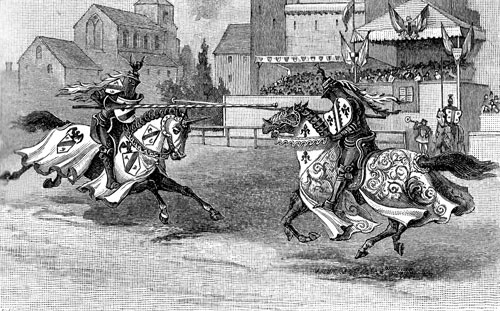
Have you seen Full Metal Jousting on the History Channel? Have you seen the collision of lance and armor? It is an incredible spectacle. It is also a real life history lesson for the writer who wants to depict a medieval setting. There’s no staging of hits. There are no theatrics other than what comes from the drama of watching repeated collisions of horse and rider and lance. It’s the real deal and it is an intense sport reborn for modern times.
Each episode has added two or three facts about jousting that are terrific details for the writer. For example: in one episode a smaller horse was chosen to give the rider the advantage of targeting up at the opposing rider – a greater chance to unhorse than targeting down. In another episode they talked about the need to release the reigns once the horse and rider begin their charge down the lane. The reason is so that when (not if) when they are hit – if unhorsed – they don’t pull the horse down with them and hurt the horse. Knights then retake the reins after they pass their opposition so they can stop the horse. Another example: armor weighs 80 pounds and knights (what else can you call them?) walk funny in full armor – legs out a little wider, more bent, torso stiff, neck immovable. Another example: the horse is as important as the rider and the relationship between horse and rider is critical to success.
If you’re writing about this time period and wanted insight to the practice this is the perfect show to watch.
I wrote a lot about fencing in my novel Open Wounds. I have fenced on and off for some thirty years, mostly épée, but also foil and saber. I’ve also choreographed and taught stage fencing using rapier, case of rapiers (two at once), rapier and dagger, short sword (like épée), and broadsword. I’ve done these things because I love playing with swords (who doesn’t?) and I’m fascinated by them (who isn’t?). They also inform my writing. Giving me details about combat with swords that would be difficult to get without the insight of personal experience.
 |
 |
A writer named James Duffy, who has written a wonderful pulpy series of historical novels about gladiators in ancient Rome called Gladiators of the Empire. On his website you can see pictures of him doing gladiatorial reenactments with a group of re-enactors in New england where he trained for two days as a way of doing research. I have to say… that sounds like fun.
This is one of the wonderful parts of writing – doing so that you can write more authentically. It’s opportunity to learn and fun. I wrote a novel (one more revision still needed) with a protagonist who played a Warhammer like fantasy miniatures game and collectible card games like Magic The Gathering. I played these games at a gaming club for a year – doing research, and having a lot of fun.
Does it mean you have do what you write about? No. Can it help? Yes. Do you have to do what you write about? It depends (on what you’re writing about).
And in case you haven’t seen the show – check out Full Metal Jousting and let me know what you think.
Sword Master Bob Anderson
 Bob Anderson died yesterday at the age of 89 and with his passing another legend of behind the scenes hollywood sword masters passes with him. He worked with Errol Flynn in Masters of Ballantrae, Antonio Banderas in his Zorro films, Johnny Dep and Orlando Bloom in The Pirates of the Caribbean, all three Lord of the Rings films, and the first three Star Wars films with George Lucas. He choreographed the fights as sword fights before they became, in the later Star Wars films, fights of acrobatic fancy with a little swordplay mixed in-between. Anderson was the real deal, fencing in the Olympics three times, coaching the national team, and from all the gossip you could gather, was a perfectionist that actors loved to work with, a gentleman, and an overall good man who simply fell in love with the sword as a kid. His style of choreography and his wisdom from working in the business so many years will be missed.


 Lunievicz

