Open Wounds

Latest

Travelling Blogger

Guest post today at Got Teen Fiction. I’ve a quote from my favorite Buddhist, Pema Chodron. Never met her but have read her works over and over again. She is a warrior monk of the highest order – a peaceful warrior with a ferocious heart.

Here’s the link: Got Teen Fiction

Ugly but Beautiful

John Carter PosterI saw John Carter of Mars today – three generations of men sitting in an imax theatre together, 3-D glasses on, my son between my father and me, his fingers in his ears (the sound was loud, loud, loud).

It is hard not to be disappointed about movies based on books that you love and I love the John Carter books in the way only a 13-year-old boy can. So, was I disappointed? No. Was it what I expected? Yes and no. What it fun? Yes, definitely a big yes.

The most surprising thing for me was the humanity I found in the main character, John Carter. ERB’s hero is more super hero – man of no age – always 40 – with little known past except for the civil war. This John Carter has a history of loss that surprised me in its authenticity. It made him different from my memory of him and yet in some ways better – more human.

The frame of the movie that so many critics complained about as incomprehensible I found to be well done. The screenwriter’s combined the beginnings of the first and second books – wonderful openings, both, and created something that worked as a frame. It was atmospheric and felt like the books in tone even if it was not exact in detail. The world building was wonderful, from the clothes (what there was) and flowing capes, to the body henna tattoos, to the design of the cities and airships. It all thundered and whispered and muscled its way across the screen, raising martian dusk in its wake.

My three favorite images from the film were the following:
1. Waking up on Barsoom. The desert and the silence and vastness was captured beautifully from the Arizona desert to the dry ocean bottoms of Mars. That was a cool moment and made me think, yes, these film-makers got it right.
2. The image of John Carter leaping into the center of a chasing green martian horde and fighting against all of them until he is buried by their numbers. This was an image right out of the Frazetta line drawings. This scene was intercut with flashback’s to John Carter’s past on earth and surprised me in its power.
3. Every moment a green martian was on the screen. They were too thin and wiry but grew on me as I forgot quickly they were CGI and saw them as real in a matter of moments. The facial expressions especially were so real.

These three things and the frame made the whole movie for me. There was sword fighting, airships, CGI to make my eyes pop. But there was also a good story – a love story – that survived the meshing of books in the screenplay. ERB was, if anything, a romantic at heart with princesses always being stolen away from their loves and heroes always following after them. His princesses were also tough, wielding weapons as ferociously as their mates. John Carter, the movie, got this right too. Dejah Thoris was perfect.

What was best, though, was having my son and my father with me, sharing smiles and losing ourselves in Barsoom only to be brought back to earth and the familiar presence of my father and my son. My son gave it thumbs up. So did my dad. It leaves me to of only one thing more – I hope there’ll be a John Carter II.
Gladius Tattoo

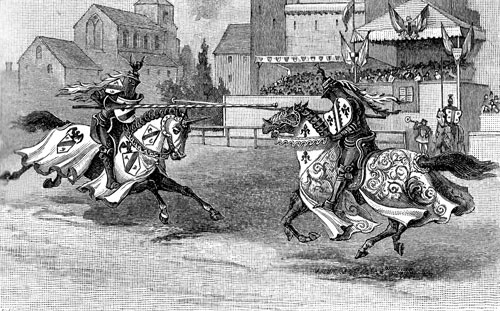
Take a look at this video and then come back. Go ahead. Full Metal Jousting.

Here’s a variation on the theme of writing what you. What if you write about something that you don’t know? Can you still write about it? The answer is both yes, no, and… it depends.

Have you seen Full Metal Jousting on the History Channel? Have you seen the collision of lance and armor? It is an incredible spectacle. It is also a real life history lesson for the writer who wants to depict a medieval setting. There’s no staging of hits. There are no theatrics other than what comes from the drama of watching repeated collisions of horse and rider and lance. It’s the real deal and it is an intense sport reborn for modern times.

Each episode has added two or three facts about jousting that are terrific details for the writer. For example: in one episode a smaller horse was chosen to give the rider the advantage of targeting up at the opposing rider – a greater chance to unhorse than targeting down. In another episode they talked about the need to release the reigns once the horse and rider begin their charge down the lane. The reason is so that when (not if) when they are hit – if unhorsed – they don’t pull the horse down with them and hurt the horse. Knights then retake the reins after they pass their opposition so they can stop the horse. Another example: armor weighs 80 pounds and knights (what else can you call them?) walk funny in full armor – legs out a little wider, more bent, torso stiff, neck immovable. Another example: the horse is as important as the rider and the relationship between horse and rider is critical to success.

If you’re writing about this time period and wanted insight to the practice this is the perfect show to watch.

I wrote a lot about fencing in my novel Open Wounds. I have fenced on and off for some thirty years, mostly épée, but also foil and saber. I’ve also choreographed and taught stage fencing using rapier, case of rapiers (two at once), rapier and dagger, short sword (like épée), and broadsword. I’ve done these things because I love playing with swords (who doesn’t?) and I’m fascinated by them (who isn’t?). They also inform my writing. Giving me details about combat with swords that would be difficult to get without the insight of personal experience.

A writer named James Duffy, who has written a wonderful pulpy series of historical novels about gladiators in ancient Rome called Gladiators of the Empire. On his website you can see pictures of him doing gladiatorial reenactments with a group of re-enactors in New england where he trained for two days as a way of doing research. I have to say… that sounds like fun.

This is one of the wonderful parts of writing – doing so that you can write more authentically. It’s opportunity to learn and fun. I wrote a novel (one more revision still needed) with a protagonist who played a Warhammer like fantasy miniatures game and collectible card games like Magic The Gathering. I played these games at a gaming club for a year – doing research, and having a lot of fun.

Does it mean you have do what you write about? No. Can it help? Yes. Do you have to do what you write about? It depends (on what you’re writing about).

And in case you haven’t seen the show – check out Full Metal Jousting and let me know what you think.

Of Swords and Thunderstorms

I have circled this story again and again in my life.

I see it.

I try to write about it.

I fail.

I see it again.

John Carter comes out this Friday and I’m going to go see a morning or early matinee showing. I’m going to play hooky from my day job. I don’t know how I’m going to do this because I’m booked all day with meetings, but I will.

When I was 13 my best friend was hit by a train and lost his life. It was an accident but no one knows what happenned. No one – not even me. It is a mystery shrouded in a thunderstorm, black skies, and torrential rain.From that day on I picked up Edgar Rice Borroughs’ books from a local stationary store – Wientraubs – and started reading them. Before that moment I was a reader but not with the same intensity, the same desire to disappear that I had after my friend was killed. When I ran out of the titles that Wientraubs carried I went to Walden Books and BDalton. This was long before superstores had taken over the landscape. I read and read.

Reading didn’t bring my friend back, but over time it made the pain less. The first ERB I’d found was The Gods of Mars the second book in the John Carter series. At the time I didn’t know it was a series. All I saw was the incredible Frank Frazetta cover and knew I had to read it. It had been published originally in 1918 but this edition – from the 70’s – had Frazetta’s muscular artwork in line drawings all through the narrative.

The scene that captured my imagination – and captures it still – is the opening. John Carter raises his arms to the skies, looks up at the Red Planet and wishes for it to carry him across the cosmos.

And it does.

I’ve waited 37 years for a movie to come out telling this story and this Friday it appears in movie theaters near you and me.

I’ve got issues about John Carter. I circle around them, though not as much as I used to.

Issues make the writer.

They form the landscape of each of our own individual planets.

They fan the desire to help others transport to worlds they’ve never even dreamed of – even if the world is just like the one they exist in now.

Maybe I’ll see you there – in the darkness of the movie theatre.

If I do.

Bring popcorn.

No butter.

Guest Post at Got Teen Fiction


Go on over to check out my writing prompt and post on Triffids and Tribbles. Has anyone actually read The Day of the Triffids by John Wyndham? My 12th grade English teacher read it out loud to us in a sci/fi writing elective class and I loved it. It’s a classic end of the world story from the 1950’s about walking talking, hungry seven foot tall plants.

Here’s the post: From Triffids to Tribbles