
Open Wounds

Latest

Ms. Maddy’s 8th Grade Class

PS/MS 161 Thank You's!

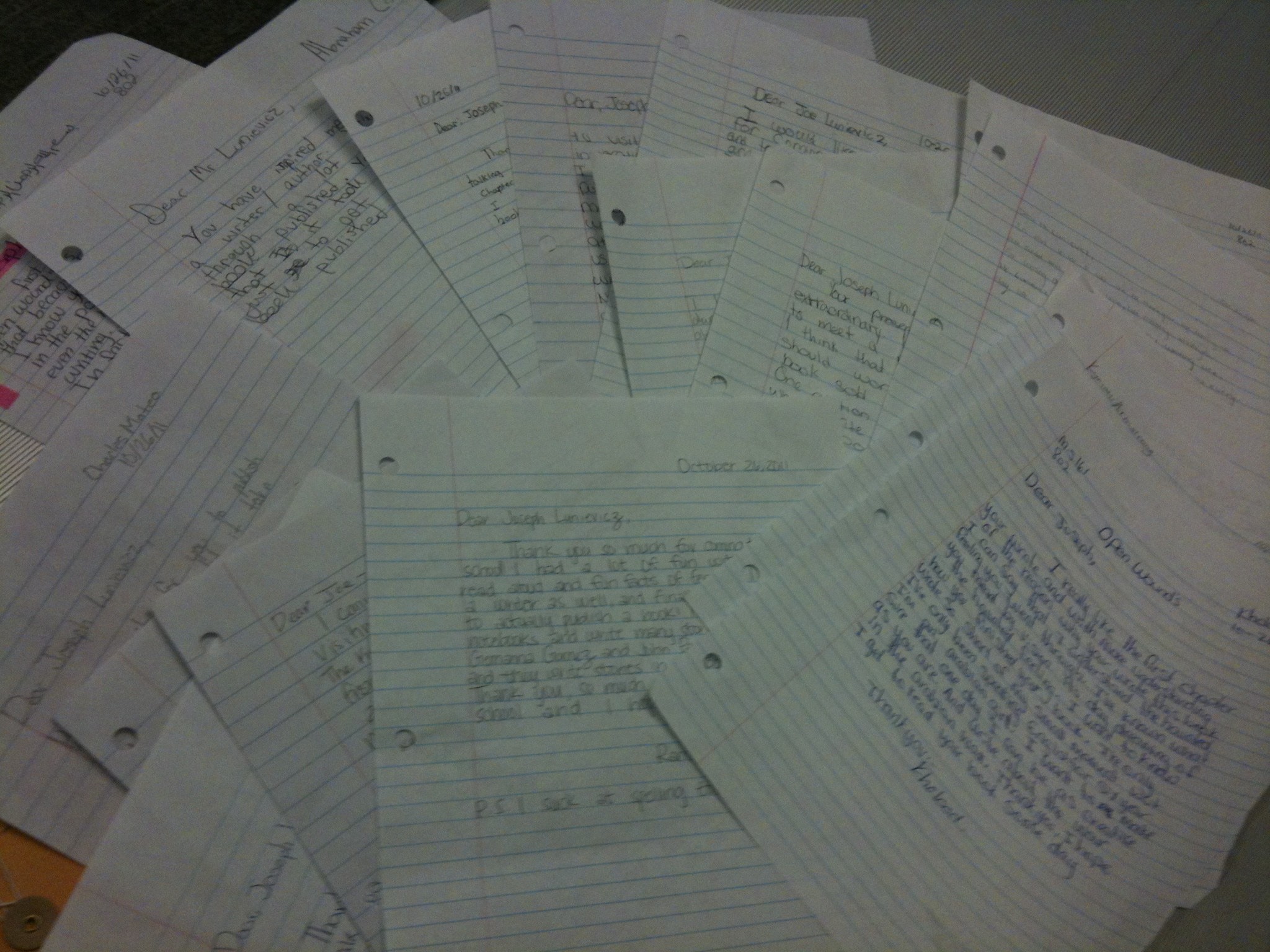
They wrote me letters.

My friend Leslie handed me a stuffed white envelope filled with them. They run from quarter page to full-page, are written in black pen and blue, with some in pencil. Some say Dear Joseph and some say Dear Joe, some Mr. Lunievicz and some Joseph Lunievicz. They all thank me for coming to their class so I’ll only share a few over the next couple of posts. I hope you find them as fascinating and wonderful as I do.

Dear Joseph,

I really like the first chapter you wrote and with more understanding of the reason why you wrote this book I can say that I understand the haunted feeling you went through. I’ve known what you meant by vision it’s day dreaming of the haunted feeling. I want to know how you finished your book. I’ve only wrote so short of my small moment but I’ve only been speaking English for six year. I’m an Arabian girl. I want to make sure that one day I can be as creative as you are. And write abou the war in the Arabian war. Thank you. I hope I get to read your book some day.

Thank you:- K.

I told them about my vision of a 72-year-old Cid Wymann (protagonist of Open Wounds) on the roof of the Chelsea hotel dueling with sharps with a man whose face I couldn’t see – the idea which consciously began the Cid Wymann story. I am always amazed at what people hear when I talk – what sticks with them as important. I love this letter.

Dear Joseph Lunievicz,

Thank you so much for coming to our school! I had a lot of fun with the read aloud and fun facts of fencing. I am a writer as well, and finally I know how to actually publish a book! I get compositions notebooks and write many stories. My friends G. and J. are me “editors” and they write stories in notebooks as well. Thank you, so much for coming to our school and I hope you come again.

Your Truly, R.

PS I suck at spelling too.

Okay. So I told them all how bad at spelling I am and at least one student heard that and took heart that she could be a writer in spite of being spelling-challenged. She’s even got an editorial pack already in place. I can’t wait to read one of her stories.

Dear Joseph,

I thank you for coming to 161 and telling us a little about your life and your book “Open Wounds”. I’m going to read that when I’m done reading my “Vampire Prince” so I thank you for coming and may god Bless you.

Sincerely, I.

Honestly, I was not hurt to hear that a vampire prince came first. I wouldn’t expect students to put down what they’re reading and start my novel. They should at least finish the chapter. But seriously, who said boys don’t read?
From now on whenever I get down about the publishing business or about the writing process I’m going to take out the letters from Ms. Maddy’s 8th grade class… and smile.

Of Egos and the Red Pen of Perfection

This is the final question from a CW Post student from my reading there last month.

How do you deal with a returned and edited manuscript? It’s perfect when I hand it in.

The woman who asked this question was terrific. She knew exactly what she was asking and knew the answer but wanted to know how to deal with the red pen of perfection. Most of us think our work is perfect or close to perfect when we hand it in. Otherwise, why would we hand it in? Then an editor gets ahold of it and either slants it with language they like, find ways to make it better, punctuates it in another style, or challenges us with new questions that we have to answer in order to make the piece complete.

I knew exactly what she meant. Man did I know what she meant. Even though by this time in my writing career I’m accustomed to revision after revision after revision I still hate to see an editor’s red marks on my manuscript. It hurts. There’s no way around it. Why do they want to change my words or punctuation or thought process as filtered through the words on my page?  Usually it’s because… it could be better.

I think every writer gets to the point when they’re working on a book that they just don’t want to see it again – ever. I love my books, but I also want them to be finished. I always get to the point that I don’t want to work on them anymore, even if a little part of me knows there’s more work to do. For me it’s usually a good time to let the manuscript sit like for a month or three or six. Even a week’s break after an intense period of time with a manuscript can give a whole new perspective on the piece – especially if it’s not working – and I realize it’s not working – even if I don’t want to admit it out loud.

But feedback is always difficult to take in if it’s negative and if it’s true. Either one. Now saying this – know that sometimes editors are wrong. The same goes for fellow writers in a critique group and your life partner (but my wife is always right about my work – she just is). You just have to follow your gut as to what needs to be added to your manuscript, what needs to be cut, and what needs to stay the same. Over time working with someone on different projects you learn to figure out what to ignore and what to listen to.  And as a writer I think each of us learns to shape our work and give it structure that is true to what we’re trying to say. Your sense of structure – of beginning-middle-end – tells you you’re on or off target with what you’ve written.

So how do I deal with a red-inked manuscript? I take a deep breath, read through the edits, accept what’s better, and cross out what’s not. It sounds simple but it’s really a lot harder than it sounds, because it will only work if my ego is in check and I can honestly tell what’s better and what’s not. And the ego, my ego, is a tricky writing partner. But the subject of ego is for another post and a brand new, rollerball, red ink pen of perfection.

A Boneflowers Halloween Story

It’s late Halloween night. My family is off to bed and I’m ready for sleep.

I’m posting a second time today so I can say its a Halloween post.

This is a short story I published in Dragon Magazine in 1996. The editor at the time called me and told me she picked it up off the slush pile and couldn’t put it down. “We never pull from the slush pile anymore,” she said. “But with your story we did.”

It’s one of my favorite stories and it’s a scary piece, though perhaps not in the way today’s scary works. Within it are hordes of skeletons and one in particular named Loomer Thomp. I hope you like it.

Click on the link to read…  Harvesting the Boneflowers

Can I Revise That Question as an Answer?

Back to the fifth question from the CW Post LIU reading last month. I got a similar question last week from an 8th grade student at MS161 but I’ll tell you that one in another post because it’s more business oriented and I answered better.

I want to get published. How do I go about it?

She was a young woman with a big smile and she asked the question with an earnestness that broke my heart. “I’ve always known I want to be published,” she said. “Always.” She stood in front of me, nervous, smiling, smiling, smiling.

“That’s great,” I said, smiling back. We both stared at each other for a few moments.  It felt a lot longer to me so, uncomfortable I forged ahead. I’d just had a conversation with a young man before her who wasn’t sure what he wanted to ask me and I’d had to investigate by getting some clarity from him about his needs. “Do you want others to look at your work? Do you want to be published?” I asked these questions because I know not everyone who is a writer wants to be published and I want to be respectful of that. Anybody who writes in any context is flexing an important creative muscle and should be encouraged to continue. Some people write just for themselves. Some for their friends and family. I’d asked him because I wanted to find out what his writing needs were. This woman with the big smile knew what she wanted, very similarly to myself when I was her age. I wanted others to read my work. I wanted to be published.

But I needed more information to be able to answer and she seemed stuck. So I asked, “Do you have finished work – a novel, or short story, or poetry?”

“No.”

We stared at each other a little longer. I took a breath and nodded. “Then… you should finish your book, or short story, or poem and… send it out. That’s kind of how it works.”

She nodded and her smile (I didn’t think this was possible) got even bigger.

Then I realized what an idiot I was being.

“Okay,” I said. “I mean try not to stress over how to get published until you have something ready to publish. That’s what I really mean. You know what I mean?’ Yes, I know I was getting more eloquent as I went on. Right about now I wanted someone to get a hook out and take me off stage with a yank. Or a brick and hit me over the head with it. But there was no hook or brick and I went on anyway. “And when you’re ready you can go to The Writer’s Market and search out markets to send to, unless you already have them in mind for your work depending on what you’ve written.  But, as my grandfather used to say to me, ‘How you going to get something published if you don’t send it out?’ So if you are the kind of writer who wants to see their name in print then sooner or later you’re going to have to do some marketing and The Writer’s Market is as good a place as any to start.”

“Thank you,” she said and she walked away.

Fortunately there was one more person behind her on line so I had one more chance to redeem myself. I’ll tell you her question tomorrow.

7 Years Lost and Hard Labor Found

I went to Harlem today to visit a middle school’s eighth grade – PS/MS 161M, Don Pedro Albizu Campos School on 134th and Broadway. It’s right next to City College where I spent a year taking graduate classes in their creative writing masters program. I ran out of money after one year and never went back, but it was a good experience never-the-less. My friend Leslie set it up. She’s an Assistant Principal at the school and, after reading my book, accepted my offer to come in and talk about it with her eighth grade students.

The Library/Media Center was packed with 40 eighth graders, one teacher, and the Librarian/Media Center specialist. They had a smart board ready for me. I laid out my fencing weapons – a foil, a sabre, an épée, and a stage rapier, then talked for twenty minutes, read for twenty minutes and answered questions for ten.

Q&A can be tricky with eighth graders. There can be a lot of silence. These kids were great but I was worried at first as only one girl raised her hand. A boy and another girl seemed to raise their hands but then put them down. Perhaps it was peer pressure or maybe they were just stretching.

I called on the girl with her hand still assertively raised. Thank God she had a question. She opened a notebook she had with her, gazed down what seemed like a list of questions she had prepared, and asked the first of half a dozen that she would try to get to. I don’t remember what her first question was because right after I answered it five hands sprang into the air, then another few right after that. And the questions were good and they kept coming. Here’s a sampling of them:

  • How does publishing work? How do you get a book published?
  • Did your parents support you in trying to be a writer?
  • When did you know that you wanted to be a writer and what made you come to that decision?
  • What do you think it takes to be a writer?
  • Are you working on anything new?
  • Who was helpful to you along the way – like teachers or other people?
  • Have you met famous authors since your book was published?

But this was the best. It wasn’t one of their questions. It was their answer to a question that I asked them. “Which would you rather do, take seven years to write a novel or one month? How many say seven years?”

Almost half the room raised their hands. I was in a bit of shock. I didn’t think any would.

“How many say one month?”

The other half raised their hands.

“Of those who said seven years, why did you say that?”

The girl who asked the first question raised her hand. “Because if it takes seven years then when I hand it in, it will be perfect.” Brilliant. Absolutely brilliant.

“And why one month?”

A boy raised his hand. “If it takes only one month then I’m writing really well, really fast.” Brilliant again.

I left three books with them – one for each class teacher and one for the library. How could I not? And whoever said middle school years were the lost years?