Open Wounds

Latest

Anxiety is Your Friend

Question number 3.

How do you deal with presentation anxiety? And how did you get over your fear?

Okay. Here’s one I actually have some expertise on. I know a lot about anxiety. You could say I’m an expert on it. I’ve lived with an anxiety disorder most of my life and in spite of this have performed as a reader, an actor, and a teacher in front of thousands of individuals over the last twenty years – and I’ve taught public speaking classes to just almost as many individuals.

The woman who asked this question had taken speech class and still had tremendous anxiety when she presented in class. I told her, “Welcome to the club.” The old stat from The Book of Lists is that people are more afraid of public speaking than death, taxes, divorce, and marriage. So If you’re scared of it you’re in the right spot.

So, to the first part of the question. Am I over my fear of public speaking? Yes and no. I still have some but I’d frame it as anxiety. Some days it’s higher and some days it’s lower but I am almost always anxious before events, the bigger the event the more anxious I am. But it’s normal anxiety – what you are supposed to have in situations like this – not overwhelming. And… the anxiety is much more manageable and that is why I can function and succeed with it. And yes, I even enjoy it (the public speaking not the anxiety – though we are friendly and exchange birthday cards).

What I did was do a lot of public speaking.

I practiced and practiced in my jobs. I liked teaching so I taught in all the different jobs I had. I watched other speakers and took techniques I liked, tried to avoid ones that I thought didn’t work.

I also took improvisational acting classes and found these to be tremendously helpful in building my confidence in my ability to deal with brain freeze (when you can’t think of what to say and stand there with your mind blank like you just drank a 7/11 slurpee way too fast) and in realizing there are many ways to get from point A to point B (ie: I don’t have to be perfect in what I say – I just have to get my point across). I will also say that taking acting classes and specifically improv classes helped me as a writer to see how ideas can be generated and grown very quickly with a minimum of effort. It also helped me to learn about character archetypes and how a 3-act narrative structure works.

I also swear by yogic breathing practices (pranayama), meditation, and asana (physical practice). I’ve practiced daily for the last five years and have been studying actively for fifteen. It has been the single most powerful collection of tools I’ve found to help me deal with life in general and anxiety in the specific.

Books to look at on public speaking:

The Exceptional Presenter (the best accessible, practical, and hands on resource I’ve found so far)

Public Speaking for Dummies (hey, don’t laugh, it’s a good resource!)

SpotPress and BlogWord

Question two from CWPost students.

How do you start a blog?

This was asked by an older adult (not a younger 18-21 adult) returning to school and clearly enjoying herself. So she wanted to write for herself – “I like writing,” she said – “and knew there was this thing called blogging and wanted to know how to start one. “Can you keep your blog private or does it have to go out to the world and can you just ignore twitter and Facebook and stuff like that in your blog?” If I could ignore twitter and Facebook I believe I would but they are necessary tools of the trade. Blogging on the other hand is both fun and stretches writing muscles.

But seriously, when she asked me this question all I could think of is that I am so not the guy to answer these questions. Although I’ve started four blogs in my life so far and written for an equal number of other blogs, I’m not an expert in any way shape or form on blogs. I’m not disciplined enough (though I’m getting better) to write every day on mine, and I struggle with writing short rather than long. So I’m going to direct you to some great writer’s blogs and a blog on blogging that gives you a primer on how to start at the end of the post.

Matthew Rush’s The Quintessentially Questionable Query Experiment – because he has a number of great posts on blogs in general and how to use them for marketing. He also runs an incredible clinic on writing query letters.

Andrew Smith’s Blog Ghost Medicine because he has this terrific voice, keeps his entries short and weaves an ongoing narrative each and every day. Oh yeah, and he’s a great fiction writer to boot.

Cheryl Rainfield’s blog because of all the cool things she does on it with video’s and photos, and contests. And she’s a great fiction writer also.

How to write a blog that People Want to Read – it’s from about.com so it has to be good.

How to write great blog content – from Problogger (how can you go wrong with a name like that?).

How to Create a blog in 4 easy steps – again from about.com and very helpful/practical.

WordPress linkbecause I use them and I like them. Click the button that says get started here

What I told this woman was the following. First I said you don’t have to pay attention to twitter of Facebook if you want to just blog for yourself. Second I said there are things called privacy settings that you can use so you blog only for yourself and no one else can or ever will see your work if you don’t want them to. Then I said there were two blogging programs to look at -Blogspot and WordPress and that although I’d used both I liked WordPress more because for me it is more intuitive and easier to use.  She had tried Blogspot also and didn’t like it so she was excited at each of the concrete answers I gave her. I told her to follow their tutorials – they walk you through the process. That’s really all I’m qualified to say about blogging. Really.

But here’s what was so cool about talking to this lovely woman. She wanted to exercise her writing muscles. She wanted to see what she could do. It’s the kind of response to writing that is so hard to get from most people because I think most look upon writing as a chore and not a pleasant one at that. Writing is so much a part of the way I express myself I almost forgot about this aspect of writing. This woman had just discovered writing as an act of self-expression and it had turned her on. How cool is that?

Capabilities Wear a Cape

Here is the first of six questions I received at the CW Post LIU reading last week. It’s still strange to me why one year ago nobody would ask me these questions and now I seem to have grown in my knowledge of the publishing world so much that I now both be asked and feel like I can answer. As my wife and son would say, now I am a somebody. Somebody or nobody, here’s my answer to the first question.

Why didn’t I get an English degree? Why did I get a business degree?

I have asked myself this same question many times. I think I would have been happier in school if I had gotten an English degree or a degree in creative writing. It’s a strange thing to say but it’s the truth. I did not like getting a business degree. Two years of business school was more than enough. My honors electives and some good teachers helped me to make the best of my last two years.

I know I thought of getting a degree in English in high school but when I talked to my parents about it, my father, always practical, said, “If you get a degree in English the only thing you’ll be able to do is teach English and there are no jobs out there for English teachers. If you get a business degree you can do anything.”

So it ends up he was both right and wrong at the same time. He meant well and I was not strong enough to disagree.

When I got out of school I got a job in a small medical publisher doing customer service work. I worked next to a bunch of people like me only they had degrees in English and Philosophy and History – degrees they mostly enjoyed getting. I’ve worked many places in a variety of types of jobs since then and my degree has helped in each of them because of its practical nature. Yet, I wish some days I had gone the other route. Perhaps my path to publication would have been faster? Or maybe it was slow because I had lessons to learn about writing and simply needed time to learn them.

It comes down to two things.

One was that I was not confident enough in myself at the age of 17 to be able to say, “I want to get a degree in English because I want to write.” My father would say, “But you can’t make a living writing so make sure you have a degree to get a day job.” By the time I developed enough confidence to say, “But creative writing is what I want to do and I need training in it,” two years had already passed. By then, I figured it was best to just finish the program I’d started. So I used what I had available to me, as Lefty from my novel Open Wounds would say, “I used what I found in the trenches.” With the help of the honors program I used my elective classes to take writing workshops and business classes focused on the publishing industry so all was not lost. I graduated with more credits than I needed but I was out in four years and wrote on my own during the whole time.

The second thing is that I didn’t know enough about life, what I could and could not do, what I could challenge my parents over and what I couldn’t. That was something my brother did very well, but I did not. So using black and white thinking typical of a young adult with a still developing pre-frontal cortex and an executive suite that was just not there yet – I did what I was capable of doing. I went to business school and developed my belief in myself as a writer by writing. I can neither blame myself for my inabilities nor my parents for suggesting what they thought would be best for me.

The moral of the story? Work with what you can and what you are capable of – don’t regret what you didn’t have or were not capable of. And of course, no matter what – if you want to write, write.

Resonate…

… as in evocative of past memories.

CW Post Reading

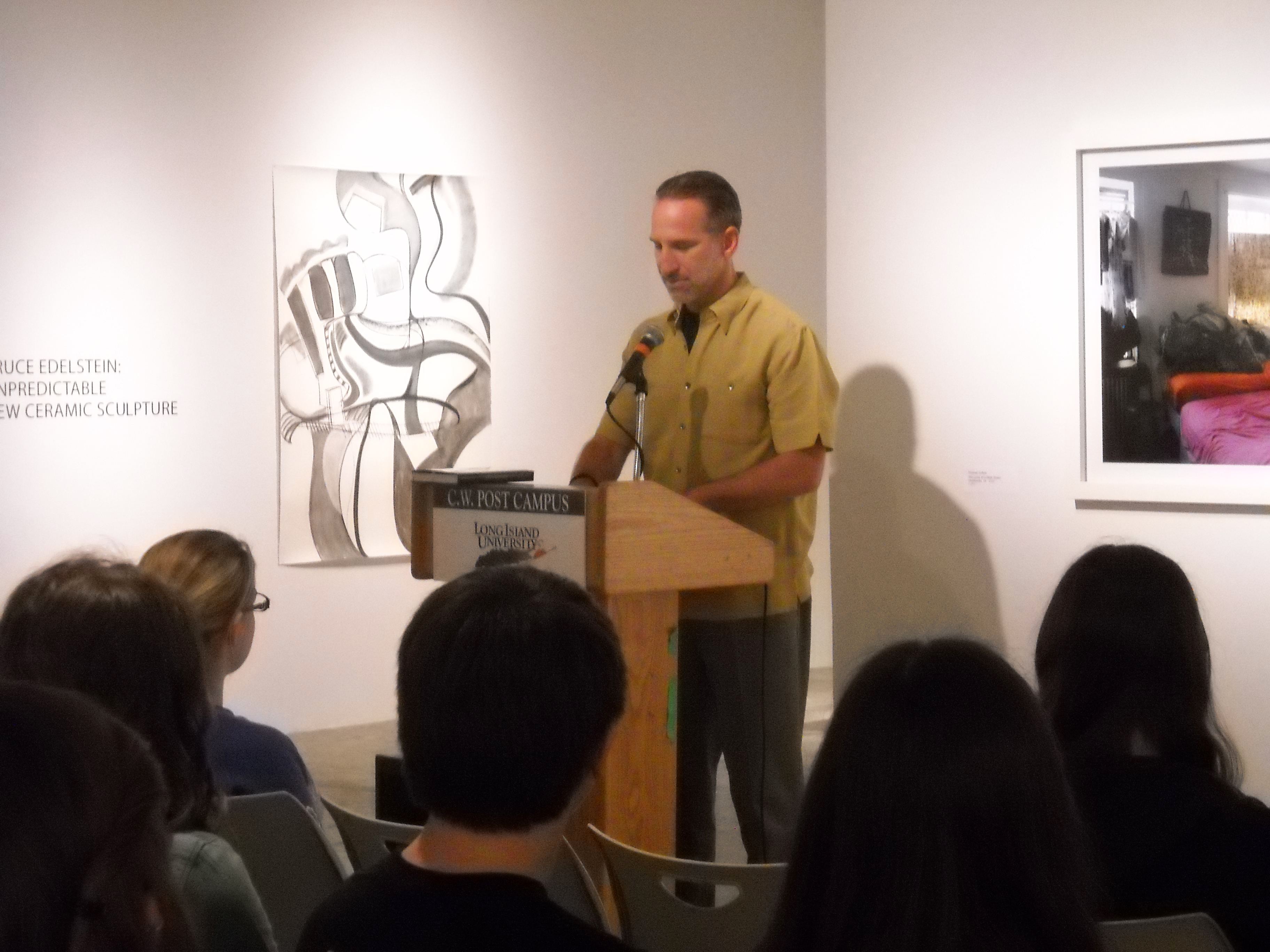
CW Post LIU Reading

The reading at CWPost was great. At least I had a good time. I think the students did also. As my friend and professor from undergraduate days, Dr. Joan Digby said, “There were a lot of people asking questions so that’s a good sign that you didn’t scare them away.”

I’ll get to the student’s questions and my answers over the next few day’s posts. Today it’s about the pictures and what resonates for me.

I went to Post as an undergrad and Dr. Digby (who is in charge of the honors program and has been so since I was there) has since invited me back a number of times to read short stories and talk about my various careers to students. It’s great to have a teacher believe in you especially long after your class-taking days are over. I’m taking her to lunch next time we get together. This kind of faith keeps a writer writing.

Art Museum at CW Post

So the reading, in the art museum at Post, as the inaugural event for their newly opened poetry center, was very cool. There was standing room only with over 70 folks in attendance – young adults to older adults pretty much 18 and up. It was something to stand there with my book in front of me and speak to folks who were in my seat thirty years ago.

It resonated like a long, loud, ringing, Om.

Brain Freeze and The Slurpie of Doom

I was interviewed by Johnny Tann yesterday for his talk radio show From My Momma’s Kitchen.

It was an hour-long and I have to say I was nervous about it. I’ve done interviews before and I’m usually nervous about them. That is as it should be. They are anxiety provoking experiences.

Things I worry about include:

  • What will I say?
  • Will I say too little? Will I say too much? I have an hour to fill…
  • Will I embarrass myself? My family? (My wife would tell me before every improv show I did, “don’t embarrass the family,” which, of course, is exactly what you do in improv but…)
  • What if I get brain freeze and can’t think of a thing to say? (It’s the slurpie of public speaking and these days I use simple breathing techniques to get through it but it does still happen.)
  • What if I say something that doesn’t make sense? (Do I ever make sense?)
  • What if I say something that makes sense but is stupid? (That puts me back to embarrassing.)
  • What if I say the word ask like ax and my family hears about it (my wife and son have been trying to help me get the New York out of my accent but it’s tough going – it doesn’t seem to want to leave.)
Since I teach public speaking I know these are all normal things to think about – to worry about. And I have ’em just like most people do too even though I’m pretty experienced at the game of speaking. But when it’s talking about my book and myself and not content that I’ve come in to teach (HIV/AIDS, Leadership, Cultural Diversity, Relapse Prevention) it’s different. This kind of speaking is about me and I find that uncomfortable. It is humbling. It is grounding. And believe it or not it is also, when it’s over especially, a bit of fun.
It helps in these situations to have a good host. Johnny was a great host and had great questions and made me feel at home. If you haven’t checked out the show here’s the link:
Now it’s time to worry about something other than the giant slurpie of doom.