F is for Fencing Measure
 Fencing measure is a stage combat term than means the distance you are at from your opponent that is safe to do your choreography from. You are out of distance of each other’s blades so you can’t be hit but close enough to give the illusion that you can be hit. It’s all smoke and mirrors I know but that’s film and theatre. It’s entertainment and safety is key. But we can learn from this.
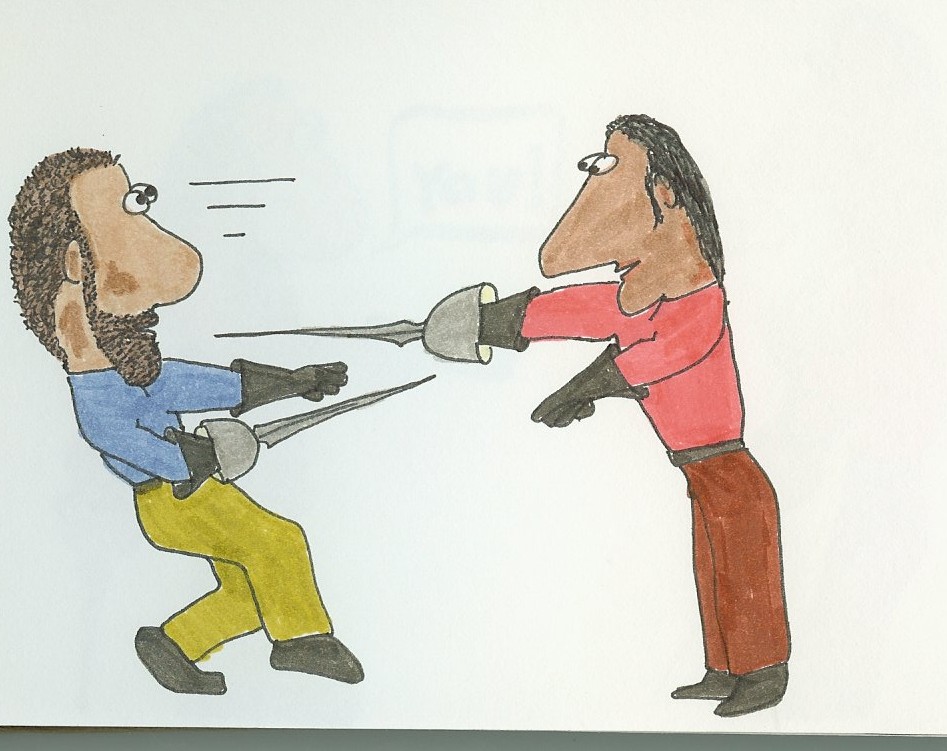
You measure this distance by, from your on guard position, extending your arm fully and touching your opponents bell guard with your point. Tip to guard. Then you are just out of distance.
Distance is an interesting thing in fencing and in a fight. Depending on the person and how threatening they seem to you and whether their weapon is drawn or not, the distance at which you might be attacked or feel threatened is very different.
In stage combat class most actors get into each other’s faces for violence and forget they have a sword at their side. They’re used to fists. They were not born with a blade in their hand or in the hand of others around them. They have not been training with a sword since childhood and seen death come to their town, city, castle, family, from the razor edge or the point of steel.
So notice that distance to attack can be as close as an extended arm plus three feet of steel. It can be two to three feet longer for a lunge distance and another two to three feet for an advance and lunge, or even further if your opponent runs at you.
Look at how distance is used in the first duel in Ridley Scott’s movie The Duelists. Notice how far they are to start. Almost tip to tip. Watch how scared one combatant is to close the distance and how quickly he leaves the killing space. Notice how Harvey Keitel (with the long hair) understands the distance so well that he plays with it.
Think of this. The edge on a sword should be as sharp as a razor. The point is like a pin.
I can tell you having seen a real machete (a slightly curved weapon that has one sharp edge used for farming and self-defense) fight in a very remote community in Honduras somewhere near the Nicaraguan border that thirty feet away was not far enough. When the combatants ran at each other and their blades hit sparks flew and people dove for cover – me included. I saw the wounds of one man up close after the fight and after applying some basic first aid – pressure to stop the heavy blood flow – helped to carry him to a hospital a few hours away on foot. I got to see his wounds up close. One wound across his chest took 34 stitches and a cut that scored his forehead near his hairline left a flap of skin that fell forward across his face. These wounds were enough to give me great respect for and want to keep a great distance from – a blade.
Distance is everything. You can’t hit someone if you can’t get close enough. And if you can hit them, they most likely can also hit you.
E is for Épée
 There are three competitive weapons in fencing today: foil, sabre, and épée. I have fenced épée on and off for over thirty years (more off than on, and with a tremendous amount of humility), tried sabre for a year or two and started with foil as most fencers do. The question is what’s the difference and why should you care?
I’ll tell you. The first cover of my book – the one that went on my ARC – was a dark, edgy image of a fencer in mask and full uniform. I loved it. Only one thing. It was a sabre fencer and my protagonist, Cid Wymann, fenced épée. I got another, better cover, with an image of a stage rapier super-imposed over NYC. Each is a different weapon with a different personality and type of fencer who picks it up.
This is important. Each weapon speaks to character and personality.
Foil is more structured and formal with a rule called right of way which dictates who can score and who can’t. You must extend your arm fully to take the attack. It makes foil more structured and in some ways artificial – more of a sport than a martial art. The target is only the torso, not the arms, legs, pelvis, or head. The blade is thin and bends. It can even be used in a whipping motion to score back hits in a move that has nothing to do with the martial art (hits over the shoulder and into the back?) of the sword. You can only score with the point.
Sabre is a holdover from rapier and calvary sabre days. It is an agressive and sometimes brutal sport (okay, okay, if you parry well you can avoid getting hit which is the idea. I get wacked because I’m slow with my parries). You can get bruised up because the thin metal blade is used to both cut (both sides are considered to be edged) and thrust (it has a point also). There is a guard to cover the hand and you need it. It uses the same right of ways rules as foil and is hard to follow because it is so fast. The target is the waist up but not the hands so the arms and head come into play and must be defended. Sabre moves fast and furiously. Sometimes you see sparks fly from blade contact.
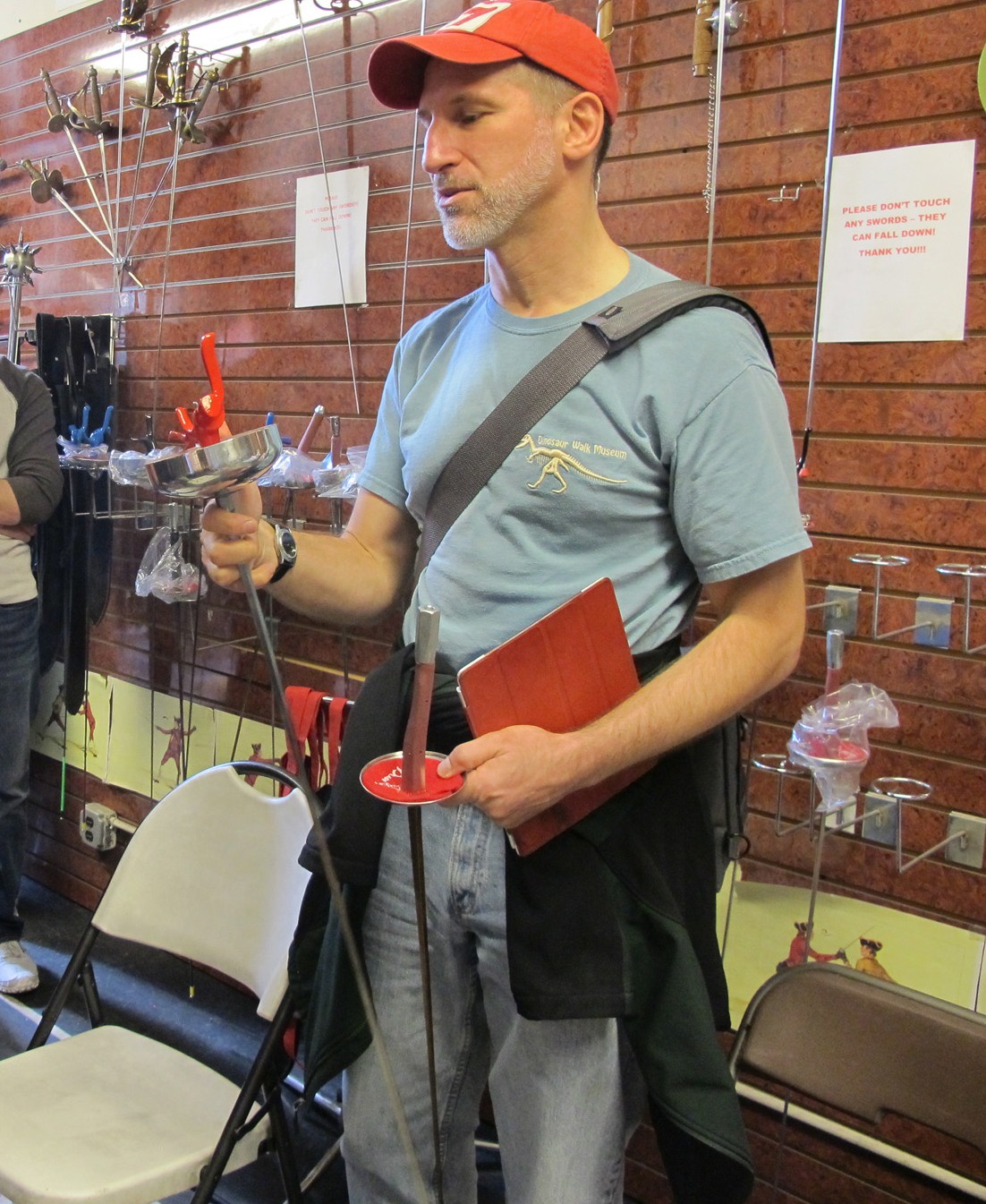
Blade Fencing Shop on 29th ‘tween 7th and 8th – Foils in hand…
I learned to fence with a foil my first two years fencing. I learned to be agressive with sabre. I learned to think with épée. That’s my story and I’m sticking with it.
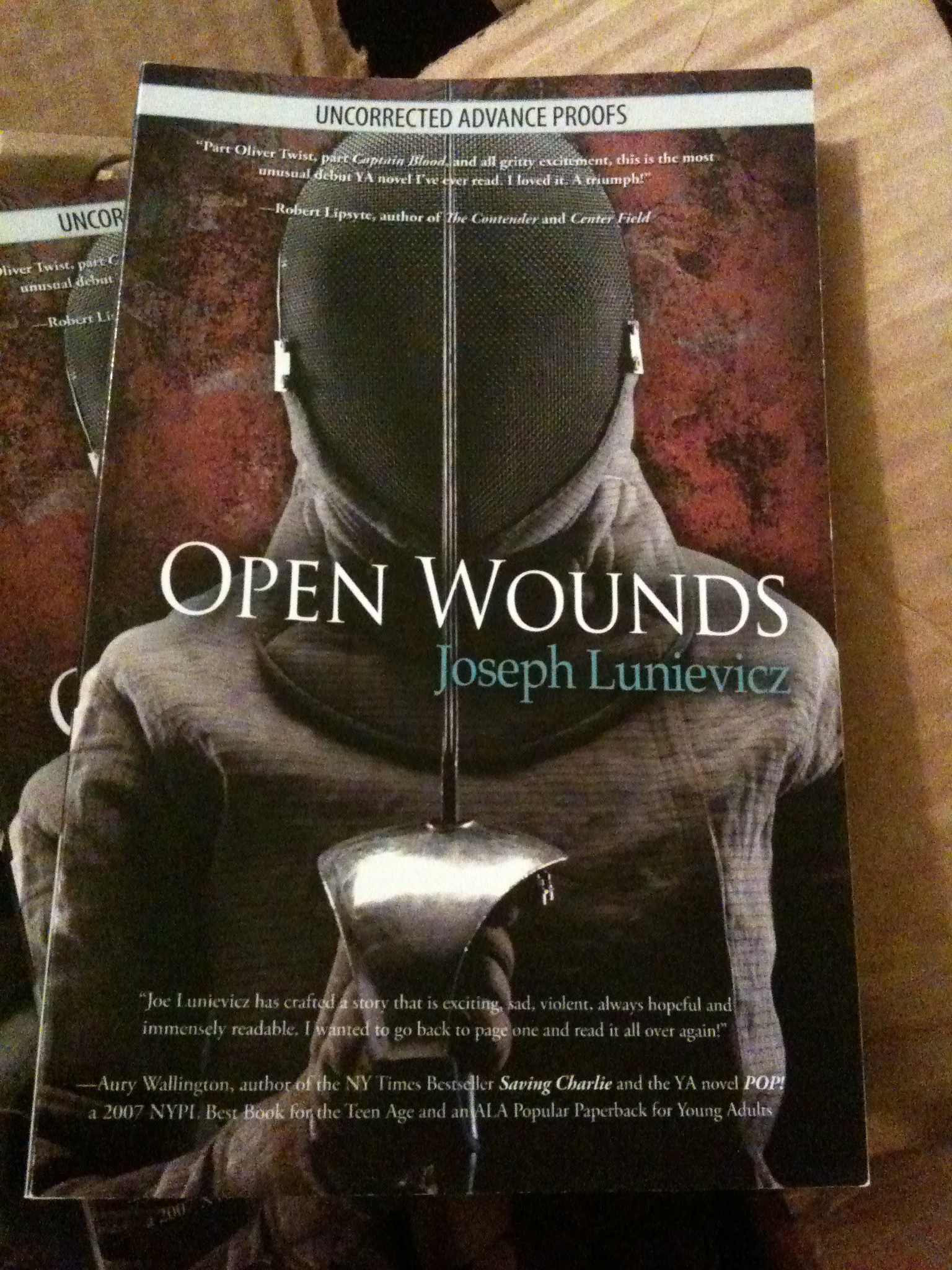
1st Cover of Open Wounds ARC – Sabre Fencer
D is for Defensive Box

“No, not a real box – an imaginary box…”
An imaginary box that encloses the combatant theoretically leaving no portion of the combatant unprotected, its walls being created by the placement of the blade when parrying. In theory, eight parries are needed to protect every portion of the combatant’s body, creating a defensive box. – Actor’s On Guard, Dale Anthony Girard
Fencing has been called contact chess and is a wonder of mathematical angles and forces in motion – a combination of geometry and physics. The exact parries will come later in the month but know that there are only so many places you can attack (the body is in a finite space) and for every attack there is a defense (parry). When it comes to defense, all parries, whether the attacks are cuts with the edge or thrusts with the point – push, hit (called a beat), or slide the blade away from your body and outside your defensive box.
A good defense is essential to staying alive.
A good offense allows you to end the duel in a positive (for you) fashion.
Imagine your protagonist is not aggressive but has learned to defend herself well. What if her opponent is of the same character make-up. Both fencers will stare at each other, make tentative moves forward and quickly back. The audience (if there was one) might egg them on. To be aggressive in attacking your opponent’s defensive box and especially the mortal wound areas – head, heart, lung, liver – requires the desire and capability to try to kill someone. How does your character get to that point? How much can training prepare someone for this moment? Killing someone with a sword is a personal, face-to-face event. It is visceral. It is immediate. It has sound, texture, smell. Don’t ask my how I know this. Let’s just say I have a good imagination.
Use these things to make each sword fight, big or small, come to life.
C is for Capo Ferro

Lunge
Capo Ferro has not nothing to do with Italian food or stringed instruments.
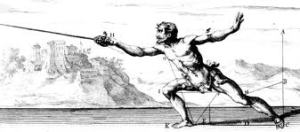
It, or rather he, has everything to do with what we know about actual rapier, rapier and dagger, and sword and buckler (shield) fighting from the renaissance period. Since we don’t have film from back then and no photographs, we have to go by line drawings and any books that were written that described it like the one above from Capo Ferro’s book Italian Rapier Combat originally published in 1610. I bought my copy in Portland from Powell’s Books (awesome indi and just a huge huge store). This book is a series of plates with short explanations of the positions and moves of Italian rapier fencing. The Italians were known in the 16th into the early 17th century to be the best with the sword. The French surpass them later but not for a long long time. Ferro was a fencing master in the city of Siena. My favorite are the many images that show (see below) what happens when you are successful in attack. Notice the three different angles the blade can take and the successful parry with the dagger.

Of course this is 1610 Italy so most people in the plates are fencing naked or mostly naked (very strategically placed scraps of cloth or leaf)- not sure I’d recommend that – must have been very hot in Siena.
Here are some words from the first section: Some Remembrances or True Advices of Fencing
First, if you are found at blows with your adversary; you must always have the eye on the sword hand more than in other places, all of the others are false, because looking at the hand you will see the stillness and all the movements that it does, and from this (according to your judgement) you will be able to determine what you will have to do.
Methods that one must hold against a brutal man:
If you have to encounter a brutal man who, without misura and tempo, hurls many blows at you with great impetus, you will be able to do two things. First adopt the interplay of mezzo tempo, as I will teach you in its place, you will strike him in his hurling of the point, either by cut in the hand or in the sword arm. Otherwise, you can leave him to proceed at emptiness with somewhat voiding the vita backwards, and then you instantly drive a point into the face or chest.
Needless to say, I chose Capo Ferro as a model teacher for my protagonist in my novel Open Wounds.
How could I not?
B is for Blade
What do you do with this thing?
You stick him with the pointy part.
Different types of blades were used in different ways. Let’s look at a typical one-handed medieval sword. It’s main weapon was its edge, not it’s point. The point wasn’t really used a lot during the middle ages. Armor stopped it. Big heavy swords were used more for smashing and hacking. Still for swordplay know that there are two ends of a sword one with a pommel (heavy enough to counter balance the blade and to smash into things like people’s faces) and the other with our famous point. The cross guard is nice for stopping opposing blades from sliding down and cutting your fingers off but also wonderful for punching into the face. You’ll notice a theme here. Pommel to dross-guard is the hilt. The blade has two parts a forte (or strong) bottom third closest to your cross-guard that is used to parry or block your opponents strikes and a foible (or weak) upper third for cutting your opponents in half. The sharp edge can be on both sides (two true edges) or one in which case the blunt side is called a false edge.
 All swords in one way or another have these parts even if they look different and are different sizes. Some things to remember about sword fights whether they are with medieval swords, renaissance rapiers, small-sword from the 17th century or the American Civil War. You can fight clean or you can fight dirty. If you fight dirty because it’s an ambush on a city street or you’re a soldier in the middle of a large battle, you will use any and or all the parts of your sword to get rid of your opponent(s). If you are fighting a duel you will probably use the blade only but that depends on the upbringing of the combatants (royalty, upper class, training, personality). And different blades are used to do different things – the use of the edge versus the use of the point. To see visually how two very different blades and upbringing can influence how a fight happens see the following two films:
Rob Roy – the final duel between Rob Roy and the English antagonist is a duels between the past (a large two-handed claymore – which is a heavy hacking edged weapon) and the present (a long, thin, pointy small sword that uses the point to do damage). This is choreographed by famous English fight choreographer William Hobbs. These two characters fight the way their personalities tell them to. The fighting is not generic, it is character-based. A good lesson for all writer’s to learn.
Watch any of the fights in Game of Thrones and then watch the scenes of Arya training with Syrio. Two-handed medieval broadswords are weapons of strength while Arya’s Needle is more point than edge (swords from two very different time periods but hey, it’s a fantasy novel so you can do whatever you want!).


 Lunievicz